
Being Film #26 for Hooptober 2025
I was trying to write this introduction when I realized that the sentence I was trying to create was immortal. That’s right: it can live forever, applied to whenever and still make sense. The sentence? Oh, “With all the advancements technology has afforded cinema in the last…” I stopped there, because there you could write any number and mean it if you were writing it in any decade – at least any decade where the concept of film was a thing. Are you still with me? Because I haven’t even worked the title of the film I’m trying to write about yet. It’s The Man Who Laughs. And it was great.
THE QUICK SUMMARY: Did you read that introduction? You think I have the brain capacity to do anything “quick” right now? I’m still thinking about whether you could apply the intro to music and what if del Toro remade this, crossing it with the ideas and concepts he had around his adaptation of The Count of Monte Cristo? Man that would be incredible. Anyway, it’s about the son of a nobleman who was murdered as a rebel by the king. The child is disfigured by Comprachicos to have a permanent skeletal smile. He grows up in love with a blind woman and comes across palace intrigue as his true heritage is revealed. I dunno, there’s a lot but I promise it all looks smashing…

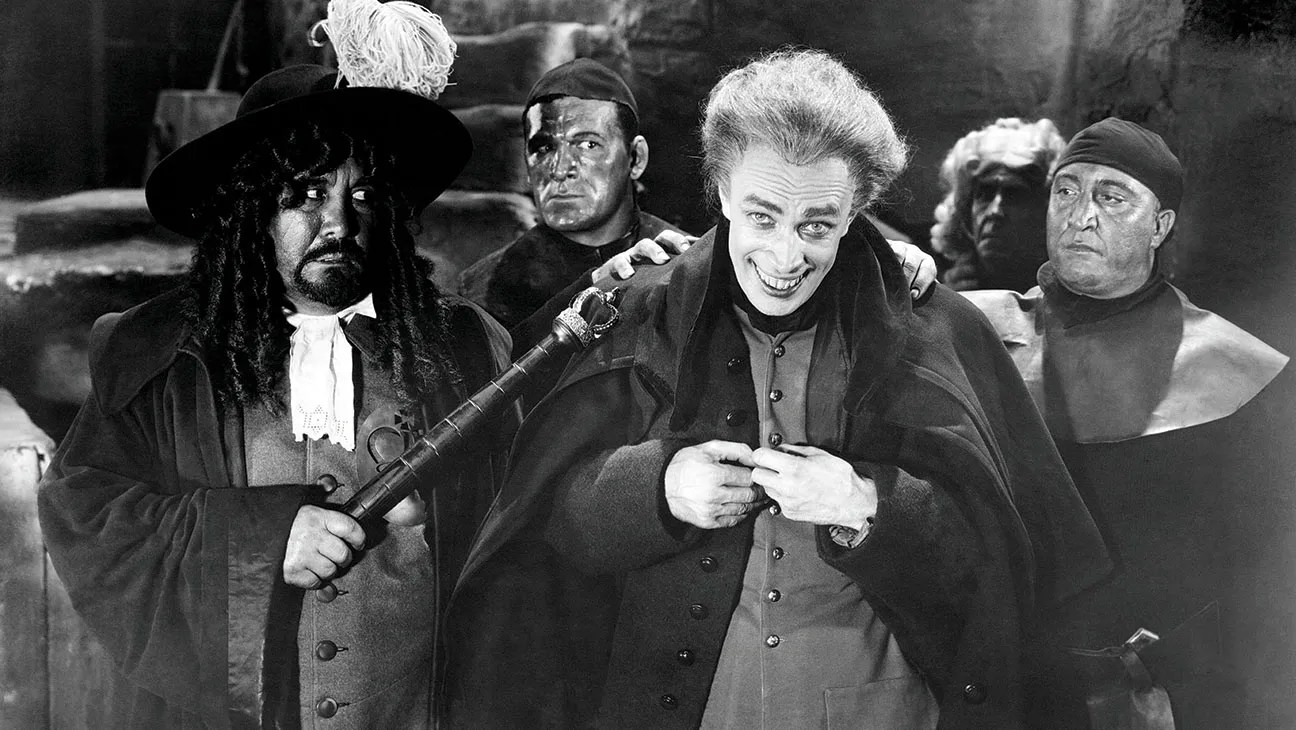
Look, here’s the thing. I really liked this movie. Paul Leni, the director, really has a sense of scale and scope: he can make things look vast and spectacular, but he also knows how to zoom in on the personal. His sense of humanity is viable in every shot: one sequence early in the film has the young Gwynplaine come across a tiny baby in the frozen wastes, still cradled in the arms of her mother, frozen to death against an embankment. The sequence radiates with sadness, horror, and genuine human empathy and compassion. Since his hideous disfigurement is hidden by a cowl, the young boy (played by Julius Molnar Jr) has to convey all this with just his eyes, and it’s a marvel.
It’s important because soon we’re with Conrad Veidt as the adult Gwynplaine and he has to do the same. He does so, magnificently, but he also has the added bonus of being able to reveal that unsightly visage, and every time he does it’s terrifying. The makeup by Jack Pierce (the guy would go on to do small films like Frankenstein) is astounding, and it’s used in such a great, fourth wall breaking way by Veidt and Leni. They use his face reveal not in any real way that makes sense to the plot of the story, but makes perfect sense to the audience watching the film. There’s no reason for Gwynplaine to hide his face in a scene with Drea, his blind love except that the sudden reveal TO THE AUDIENCE will be fantastic, and Leni leans into that with abandon.
Seriously, this film looks gorgeous, I was shocked as the condition of even public domain copies. But rather than take my word for it just see for yourself: the entire film is embedded below.
The Man Who Laughs. Damn…
 Cinema Dual
Leave a comment