
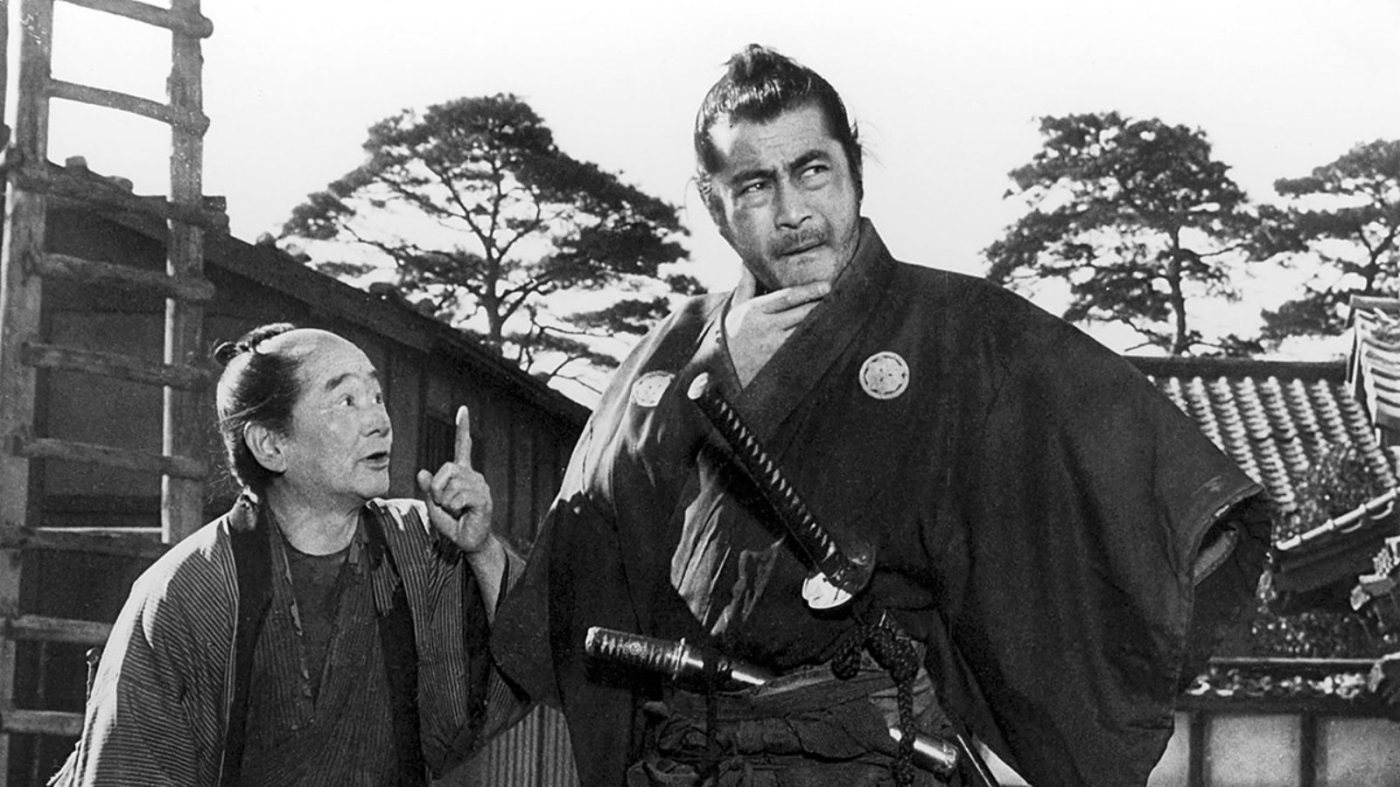
Something Like a Filmography takes a (brief) look at the filmography of Akira Kurosawa. Twice a month, Chris and Jon share their impressions of each film, both on its own terms and in terms of Kurosawa’s legacy and its intersection in the Cinema Dual hosts’ lives.
FROM THE BOX: The incomparable Toshiro Mifune stars in Akira Kurosawa’s visually stunning and darkly comic Yojimbo. To rid a terror-stricken village of corruption, wily masterless samurai Sanjuro turns a range war between two evil clans to his own advantage. Remade twice, by Sergio Leone and Walter Hill, this exhilarating genre-twister remains one of the most influential and entertaining films of all time.
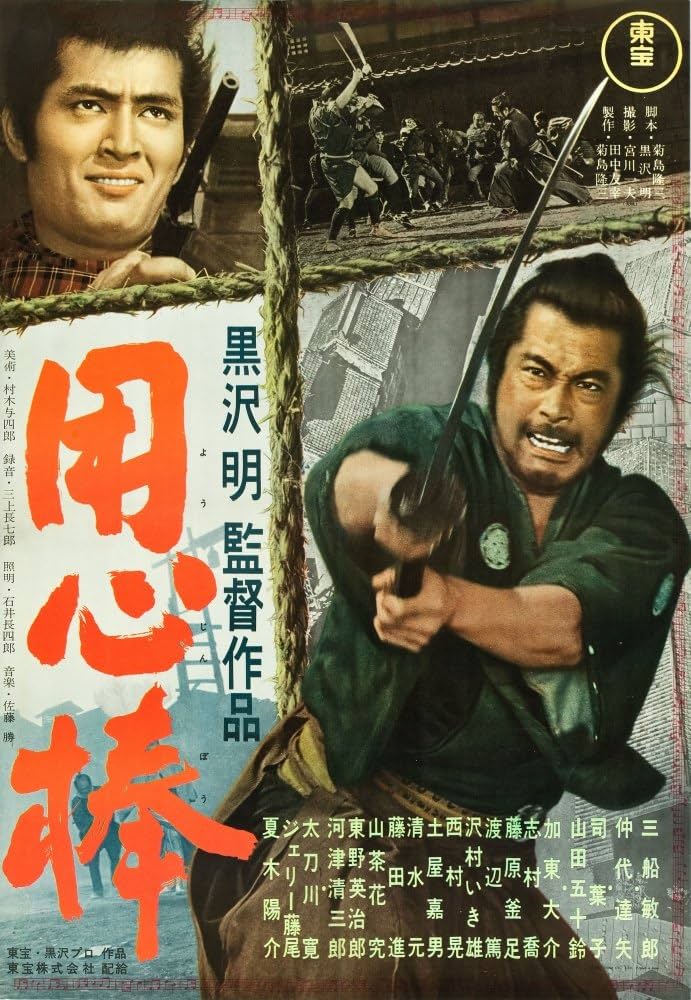
WHAT CHRIS THOUGHT: I can only imagine what it would have been like, going to a movie theater in 1961 and looking up, seeing this towering figure, literally larger than life, walk across the screen. Yojimbo is Kurosawa working in superhero mode, taking everything he’s mastered in filmmaking up to this point and putting it all in service of entertainment, of pure action and spectacle. After the heady weight of The Bad Sleep Well, it must have been a hoot to craft what at the time must have been a simple, interesting take of the American westerns that were permeating the country (according to Donald Richie Shane was a massive hit in Japan) only to have it turn into one of the most iconic stories of all time, one that would be remade again and again, and serve as the fodder for Kurosawa’s follow-up.
Is this my third time putting words to screen (I miss “pen to paper”) about Yojimbo? Back in 2020 I ported over a review from my old film blog in 2007 with additional thoughts and here we are again. It’s telling that despite this being less concerned with personal themes there’s still so much to talk about. Kurosawa has talked about the his concept of a town that is redolent with evil, and everyone – including himself – being too weak to do anything about it. So how about create someone who walks into town that isn’t weak, who could come in, clean up the mess, and leave again? His entire plan is there in the opening – Mifune’s nameless ronin, massive on the screen, truly larger than life and cut from a different cloth than anyone else in the film, going where chance (in this case, a tossed stick in the air) takes him. I love how Kurosawa ties the film in a neat bow, using the opening sequence of the young farm boy leaving his family to live a lavish life as a gambler and gangster, leaving him alive and terrified at the end for Mifune to admonish him to return home to his simple life of gruel and work. There’s so much fun to be had in every moment, and from a point of pure physicality this is probably Mifune’s greatest role.
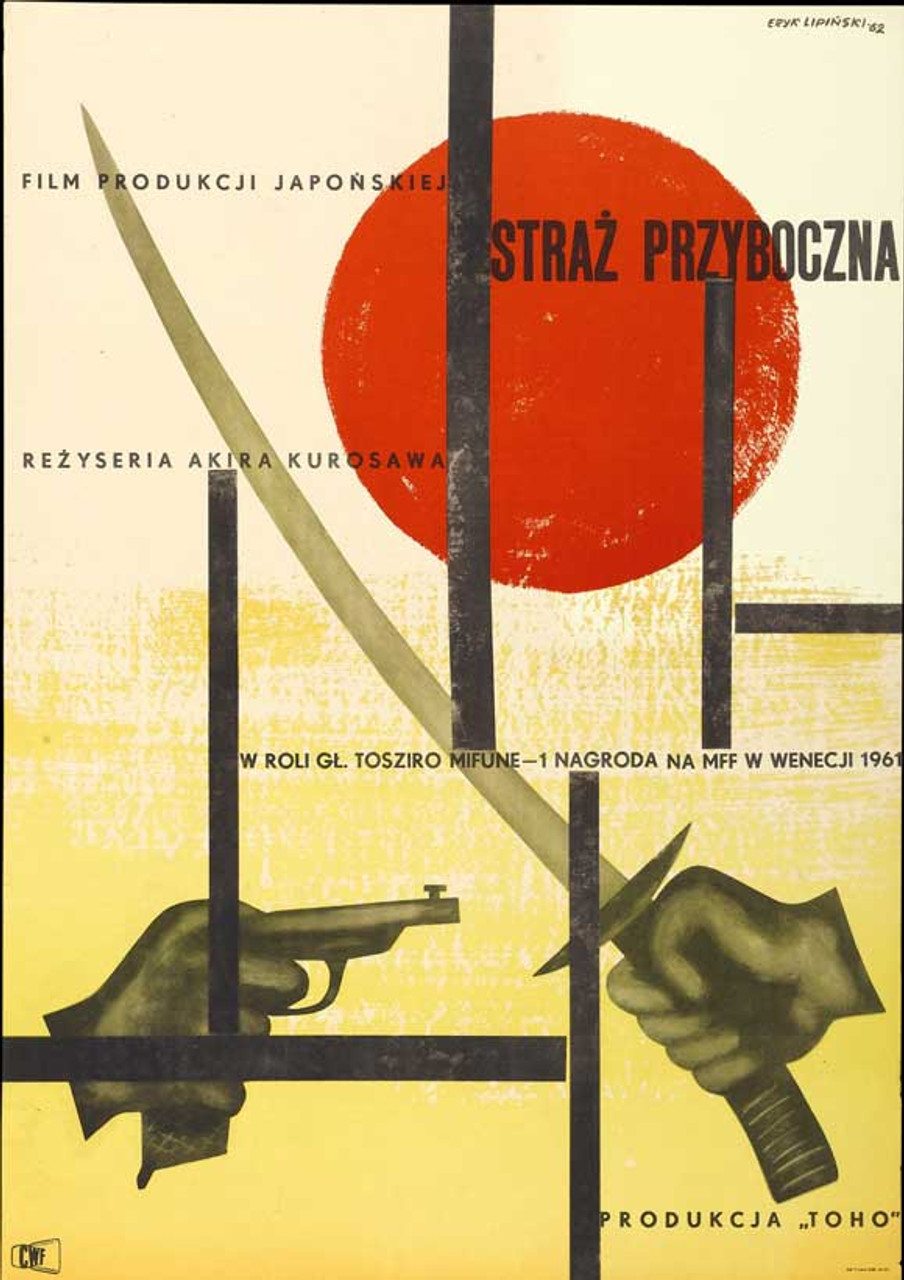
WHAT JON THOUGHT: What landed for me the most in this viewing of Yojimbo, the first Kurosawa movie I ever saw, was how Mifune’s heroism isn’t solely predicated on his skills at violence. Most of the Mifune’s plotting in this movie involves tricking both sides of the town into escalating violence towards each other and not himself. Sure, his swordsmanship is unmatched, but not only does that leave him vulnerable when separated from his sword by Unosuke, the majority of his mission is accomplished by using his own wits, and watching the results. In a movie replete with wonderful cinematography, some of my favorite shots are the various ways that Kurosawa positions Mifune literally in between the two rival gangs, observing the outcomes of his machinations.
And while Mifune gets the lion’s share of acting responsibilities here, the supporting cast of townsfolk is wonderfully stacked. Chris will deservedly talk about Eijirō Tōno below, but I want to talk about Ushitora’s henchmen. Taku Iyaku as the enforcer Kannuki is an intimidating presence and the only person in the movie that Mifune has to stop to take a second look at when sizing up his opposition. Daisuke Katō as Inokichi is hilarious as the younger brother whose idiocy doesn’t make him less dangerous. But the true standout of supporting characters is Tatsuya Nakadai, in his (not technically, but effectively) debut for Kurosawa as Unosuke. Audiences will immediately pick up on the threat of him having the film’s only gun, but he’s the only person with enough wits to match Mifune. He’s so delightfully villainous, I’m so happy we get more of him going forward in this series.
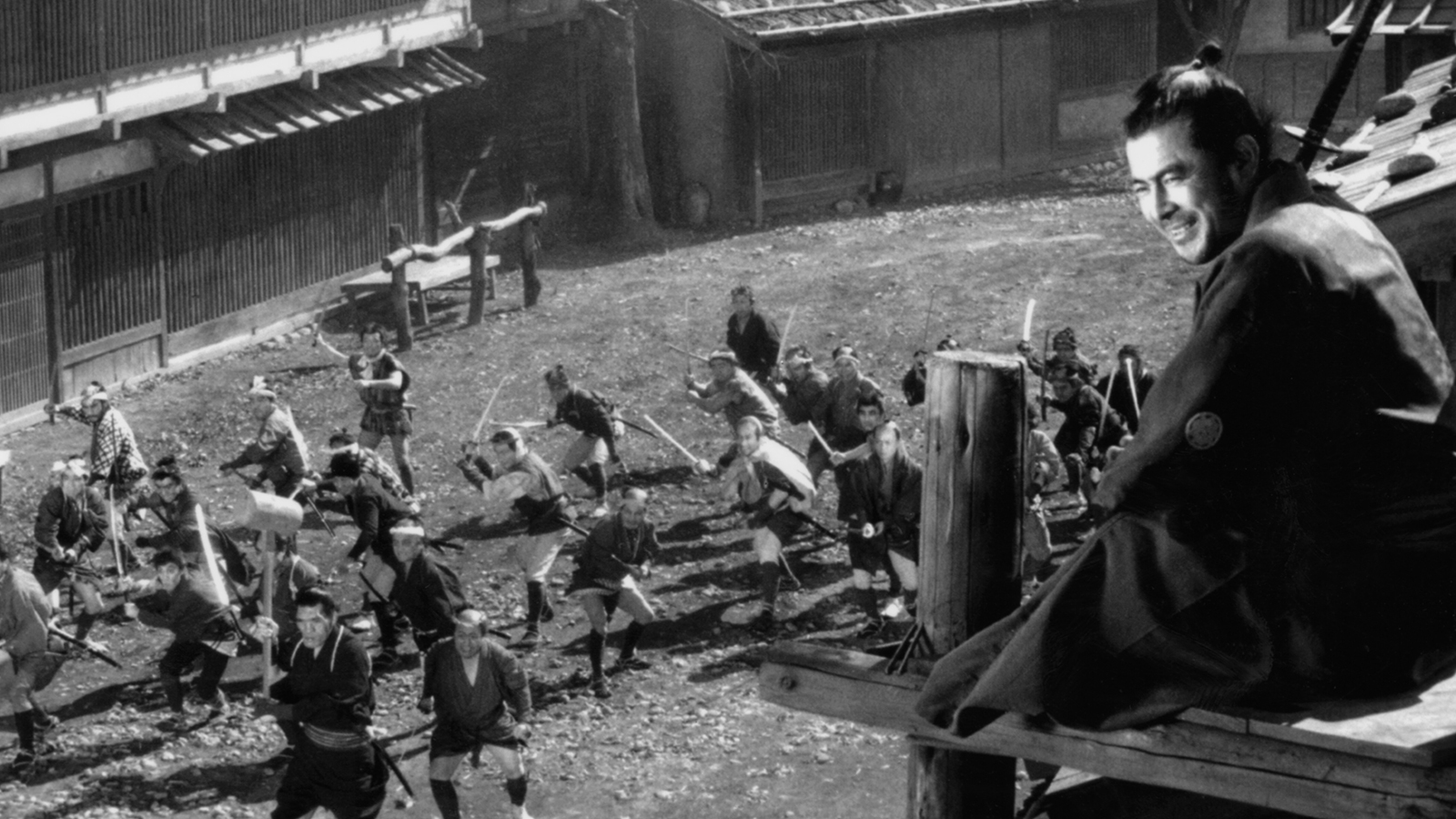
ANYTHING ELSE, CHRIS? My beloved Takashi Shimura may be relegated to a very minor role (that of Tokuemon the sake maker) but in his place as the true co-star is Eijirō Tōno as the tavern keeper and Mifune’s ally. He’s fantastic, and his grizzled face and ornery demeanor are a prefect match for Mifune. One of my favorite images in Yojimbo and – indeed – in all of cinema is that shot in the climax where Tōno is in the foreground, tied up and hanging, the Ushitoro gang in the middle ground and, deep in the distance, Mifune standing alone in the film’s showdown moment. All in perfect focus, of course. I’m also amazed at Mifune’s ability to play big without playing loud – unlike his towering presence in something like Seven Samurai, here he’s much more quiet and thoughtful, even joking. His movements are largely economical, which is great when he suddenly explodes in the film’s three action set pieces, over much quicker than any Hollywood filmmaker would have shot them.
Finally, a moment that speaks to Mifune’s character in the film more than anything else: when he creeps in to overhear the Seibei family plot his double-cross, and the boss’s concubines quiver and start to fret at his surveillance, he simply shushes them and goes back to eavesdropping. It’s a beautifully funny moment that also speaks volumes as to his character.
ANYTHING ELSE, JON? I mentioned it before, but it cannot be understated how magnificantly this movie is shot. So much credit needs to go to Kurosawa and cinematographer Kazuo Miyagawa, who last appeared in this series on one of Kurosawa’s other visual masterpieces Rashomon. In Yojimbo, the use of moveable walls in Gonji’s restaurant allows Mifune to observe the impact of his scheming all across town from that one location, in a way fills the frame without being confusing.
When Mifune does need to step directly into the action, the results are such that Westerns will forever “pay homage” to it going forward. God bless whoever introduced Kurosawa to widescreen. The last sequence that I really wanted to highlight was Mifune’s destruction of the building after rescuing Kohei’s wife Nui. In order to really sell Ushitora on the lie that an army of Seibei’s men were responsible, Mifune decides that simply dispatching the six guards isn’t enough. He then proceeds to, in a single unbroken take, destroy the entire building singlehandedly. I can only speculate on the pure joy in Toshiro Mifune’s heart the day they shot that scene.

THE FINAL WORD(S): For Chris, Yojimbo is myth writ large, one of Kurosawa and Mifune’s greatest creations, all the more impressive for what it would inspire later. It’s also a swashbuckler in disguise, and delight that never tires. For Jon, Yojimbo takes the entertaining, near-alchemical mix of cinematography, scripting and acting from The Hidden Fortress and elevates it to new levels.
NEXT TIME: Our original Man With No Name continues his wandering adventures in Kurosawa’s second and final sequel, Sanjuro.
 Cinema Dual
Leave a comment