

Something Like a Filmography takes a (brief) look at the filmography of Akira Kurosawa. Twice a month, Chris and Jon share their impressions of each film, both on its own terms and in terms of Kurosawa’s legacy and its intersection in the Cinema Dual hosts’ lives.
FROM THE BOX: A young executive hunts down his father’s killer in director Akira Kurosawa’s scathing The Bad Sleep Well. Continuing his legendary collaboration with actor Toshiro Mifune, Kurosawa combines elements of Hamlet and American film noir to chilling effect in exposing the corrupt boardrooms of postwar corporate Japan.

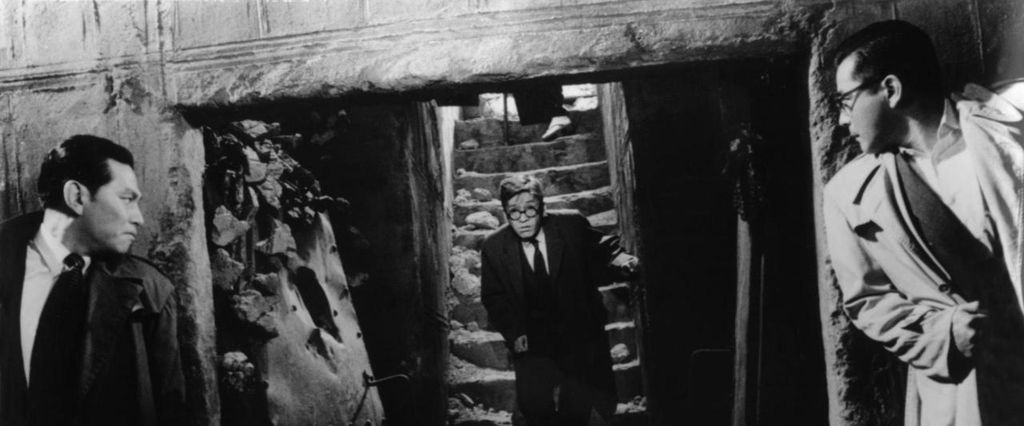
WHAT CHRIS THOUGHT: Noir is always tragic, so I’m shocked it took until now to marry the shadowy genre to arguably Shakespeare’s greatest tragedy. It’s incredible to see Kurosawa, unfettered by the studio, turn to this labyrinth play of revenge wrapped in a scathing indictment of post-war corporate Japan as his first independent film. At two and a half hours, The Bad Sleep Well is sweeping in its scope and ambition, and simply gorgeous in its presentation. Working with Yuzuru Aizawa, his use of deep focus and widescreen is somehow even more impressive than it was in The Hidden Fortress, and the heightened drama and stark use of shadow is further enhanced by Masaru Sato’s brilliant score. And while the script is admittedly a little hard to get a grasp on, what with all the exposition and characters being introduced in a rush during the opening wedding sequence, Kurosawa soon finds the rhythm and pace to allow the images to pull you along their riptide to the final, knockout conclusion.
From a performance perspective, this might be one of my favorite Mifune performances. Until the full reveal of his identity and true motivations, he’s physically meek, submissive to his superiors as the secretary to a corrupt corporation in bed with the public works department. But his sheer physicality is constantly straining to burst out, and it’s an incredible showcase, demonstrating his gargantuan presence in the simple act of handing a briefcase over, and then calmly working as the fruit of his machinations begin to unfold.

WHAT JON THOUGHT: Of the film’s many accomplishments, chief among them is making one wish that Kurosawa would have made more noir mysteries in his time, especially at the height of his powers, which The Bad Sleep Well is firmly nestled within. The genre’s emphasis on light and shadow is a great fit for Kurosawa’s visual aesthetic, and its nihilistic bent is well equipped to contain Kurosawa’s darker impulses. Unlike The Lower Depths, which was relentlessly on point in its despair, here Kurosawa deeply reworks the structure of Hamlet so that Nishi’s revenge plot is only gradually revealed, letting the audience soak in the mystery of who is trying to expose corporate corruption. Other than the fact that Nishi is played by Toshiro Mifune, one of Japan’s biggest stars, nothing in Mifune’s performance or the way Kurosawa sets up the early scenes of the movie betray Nishi’s true intentions until the reveal happens.
But the film’s true film noir moment, especially for an audience expecting Hamlet, is where not only does Nishi get murdered off screen, but Iwabuchi, Nishi’s father in law and the film’s chief villain, successfully covers up the whole affair. Sure, his children realize the truth and disown him, but beyond that there are no real repercussions for Iwabuchi’s actions. By getting the audience intrigued by the mystery and then invested in the revenge plotting, Kurosawa sets the audience up to be devastated by upending their expectations at the film’s end.

ANYTHING ELSE, CHRIS? I remember coming to this the first time, decades ago, so excited to see what Kurosawa would do with Hamlet, having come off the heels of his MacBeth in Throne of Blood. And I also remember coming away disappointed. It wasn’t a direct analog, I couldn’t make the connections I expected to, and that confusion initially soured me on the film. Coming back to it now, both as a much older person and one who has steadily been moving through Kurosawa’s filmography I can see so much more, how he (as brilliantly described by Jon in his section) uses the bones of Shakespeare’s play to construct a much more personal story, one concerned with how his country and culture was slowly becoming more twisted and selfish in the years following the war. In a fit of anger he rages at how well those evil at the top are sleeping, and it – as much as the pain of his father’s death – that push him forward.
ANYTHING ELSE, JON? While the whole film is good as a whole, the wedding reception that opens the movie is among some of Kurosawa’s best filmmaking, full stop. If we’re following the Hamlet analogy, the wedding reception stands in for The Murder of Gonzago play, moved up to the beginning of the story, wherein details of the alleged murder are recreated to try and expose the guilty parties present. In The Bad Sleep Well, that takes the form of a giant wedding cake in the shape of the building that Nishi’s father was killed in, with a flower attached to the window from which his father allegedly committed suicide.
Because the story starts with this, we don’t have our Hamlet yet to guide us through its implications, but there are a group of reporters who exist on the periphery of the scene who are constantly reporting about the people in attendance at this wedding. They immediately recognize some kind of significance to the flower in the cake, and speculate about its causes and implications. Between the shot framing and expositional dialog, this sequence sets up a lot of plot very efficiently and compellingly. It’s not a surprise that Francis Ford Coppola used this opening as an inspiration for The Godfather.
THE FINAL WORD(S): For Jon, The Bad Sleep Well is a solid mystery with moments of true Kurosawa genius. For Chris, it’s a revelation that was too long in coming, a near-masterpiece that has him wishing – as Jon said – what a bunch of noir films would look like under his direction.
NEXT TIME: No preamble here, folks. We go hard as we kick off the 1-2 punch of Mifune’s most badass character, starting with the film that launched a thousand remakes and reboots (or at least two): Yojimbo.
 Cinema Dual
Leave a comment