

Being Film #12 for Hooptober 2024
What a beautiful, messy, sloppy charmer of a film. ON the one hand, I can see what both the average movie goer – even the casual Coppola fan – would be put off by Twixt, the maestro’s 2011 “return” to horror. I can also see how those fans who loved his adaptation of Bram Stoker’s Dracula would watch this and cry foul. But my viewing found something deeply personal, deeply indebted to Coppola’s influences and preoccupations, and with his “Authentic Cut” retitled to its original B’Twixt Now and Sunrise we get a late highlight from a man who hasn’t yet quit trying to be innovative and singular with his artistic vision.
THE QUICK SUMMARY: Hall Baltimore’s latest book signing tour isn’t going well. It’s one too many witch hunter books and one too many backwater towns that don’t even have a bookstore that has him thinking he can snatch an interesting idea about a murder from the local kook sheriff. But Hall Baltimore’s nights have a very different idea, one where he travels a dark dream road where he sees the shadow of the town, the murders of children, and a very special young girl named V whose teeth may be very large…too large for those braces to hold. What does it mean, and what does it have to do with the old abandoned hotel, or the “cult” of kids who live across the lake? Who is V, really, and why is Hall drawn to this story, her story?
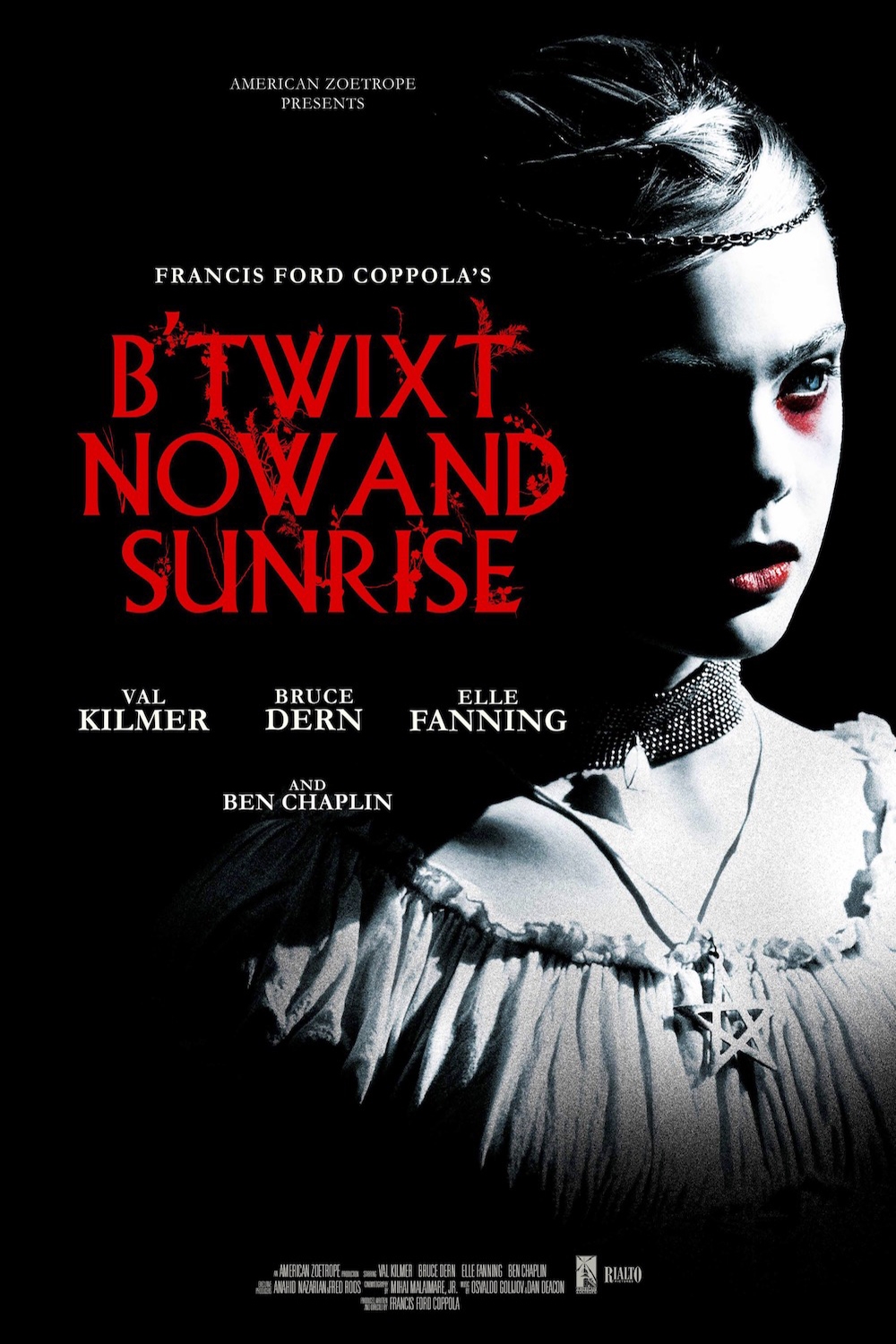
Similar to his Dracula adaptation, there’s a very intentional artificial look to Twixt (I saw the Authentic Cut but for expediency’s sake will just refer to it by the standard name) that took a little to get adjusted to, but when Coppola shifts from the mundane look of the town in daytime to Hall’s color-drained dreams of the town in shadow it’s a beautiful switch up. He plays with black and white and deep splashes of color, and injects moments of very subtle speed ramping to give the night a very different feel. And his new cut – solely removing sections instead of adding them (the new cut is only 80 minutes long) also makes Twixt at once much more ambiguous in its ending, but also much more specific and concrete about what this film really gets at: the nature of telling a story, of regret, and of loss. Without taking to spoilers (I really recommend this film) Coppola uses pieces of his own life to work through the pain of his own loss and it when its confronted, leaves little else.
Even an ending.
Performance-wise Val Kilmer gives a shuffling, why am I here? approach at first, which I first took to be his approach to the role but in hindsight suits Hall’s demeanor perfectly. That slowly changes as he becomes enamored with the idea of the new direction for a story, and there’s a wonderful scene of him drinking and trying to get an outline done, getting drunker and drunker and resorting to hilarious impressions. Bruce Dern is in full “kook” mode, and it feels just as heightened as the film. Elle Fanning is – unsurprisingly – fantastic, and ethereal in her performance. They all seem to “get” what Coppola is aiming for and provided it.
Just a few more random thoughts to close Twixt out: come for the Kilmer, stay for the appearance of Don Novello, aka Father Guido Sarducci in a small role and Alden Ehrenreich as someone called Flamingo. Marvel at how silly the ouija scene is, and how beautifully sad and gothic the ending is. This one surprised me in a great way.
 Cinema Dual
Leave a comment