

Being Film #25 for Hooptober 2023
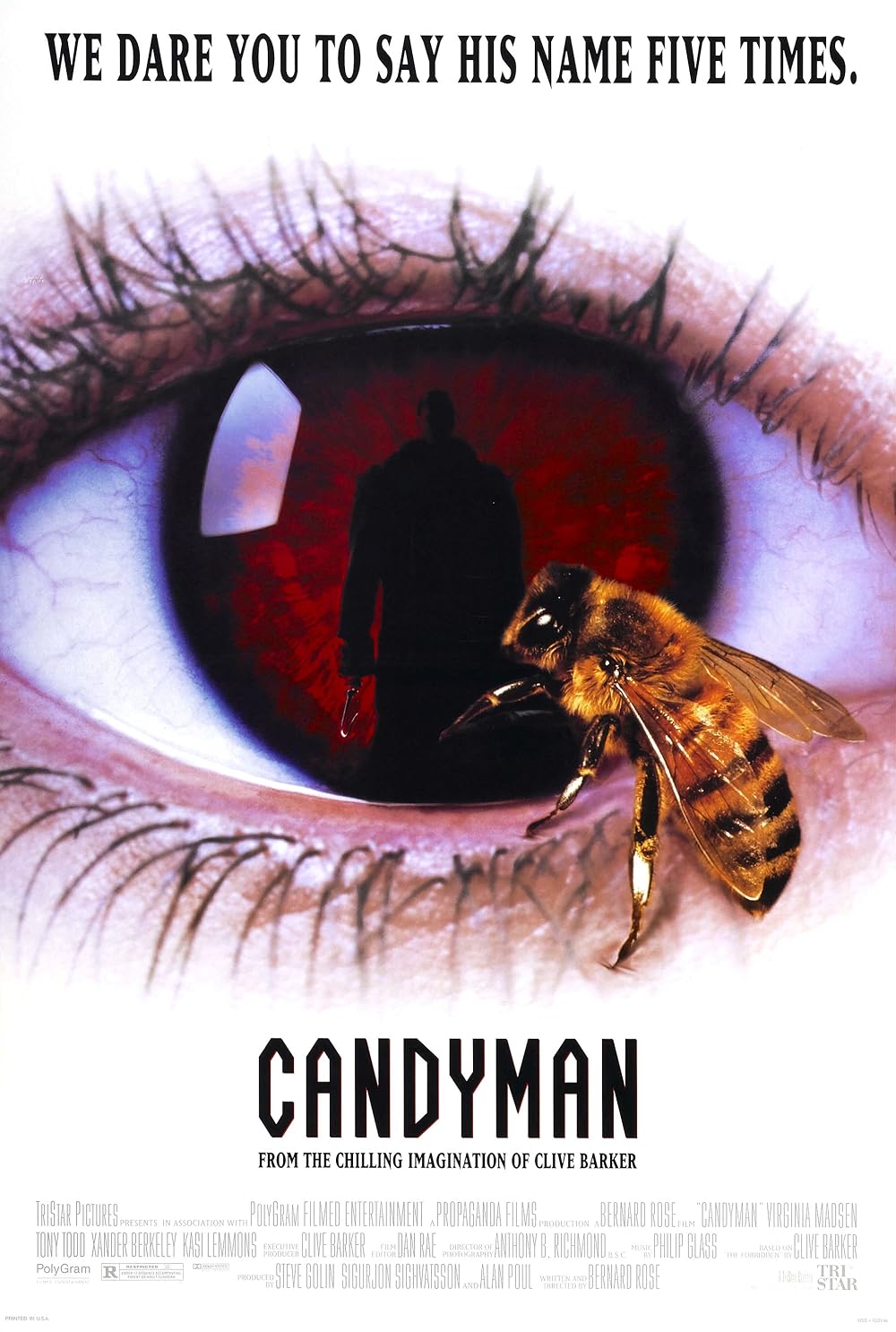
Sometimes context is everything. On its own I’ve always liked and admired Candyman, Bernard Rose’s adaptation of Clive Barker’s short story “The Forbidden” but watching it right after The People Under the Stairs I’m even more impressed. Here is a film that looks at the disparity between the haves and the have nots, the extent of white privilege and appropriation but doesn’t hit you over the head with it. Instead it all creeps out in the action and events that pry back the lid of urban legends to reveal a terrifying entity feeding off the cries and whispers and rumors emanating from the very people caught at the bottom rung of the economic ladder.
THE QUICK SUMMARY: Helen has a fantastic life: married to a college professor, living in a luxury condo with a stellar view, and working on her thesis that will be her claim to fame: the origins of urban myths, particularly the one about the mysterious Candyman, who will come if you say his name five times in a mirror. Investigating the source of the legends in the Cabrini-Green projects in Chicago learns very quickly that what seems to be urban legend is much more, reaching all the way back to history and terrible crime against a young black man not content to know his place in white society. Helen finds out that you can’t be an impartial tourist, casually dipping your toes into how “the other half lives” and that the Candyman has her in his sights to live on forever…
PLUS OH MY GOD THE BEES!
I love Rose’s direction here – it’s pretty far from the standard horror fare that was cropping up in the late 80s and early 90s. Interesting shot composition, long takes: there’s almost a Gothic sweep to his direction (credit to our own D. Morris for that observation). Two shots in particular stand out for me, one simple and one not so simple. There’s of course the great one-take of Candyman reaching out for Helen in her condo from the medicine cabinet, then following her as she races through the apartment and out the door only to see him standing in the hallway. But after that we get a truly great shot of Helen restrained on a stretcher, the camera following her face as attendants wheel her into a wing of a mental institution. There are dozens of what to shoot that very simple shot, but Rose focuses on Helen’s face, her terror and confusion anchoring us to the moment. It’s a small but great moment in a film where there are dozens of similar moments.
Speaking of Helen, you don’t this film without Virginia Madsen’s incredible performance. Watching her privilege seep away to be replaced by confusion and terror is a sight to behold, and Madsen is mesmerizing throughout the film. She’s playing in a different league from, say, the young co-ed who moves in with her husband Trevor (a solid Xander Berkeley) – there’s a scene between them when Helen escapes the asylum and arrives home to find out she’s moved in that almost fails due to how wooden Carolyn Lowery’s performance is. But when the scene switches to Helen, furious and broken hearted, it almost feels like another movie. She literally chews up and spits out everything in that scene, and it’s marvelous.
Likewise the indelible performance of Tony Todd as the titular Candyman. Studios may have lobbied for a bigger name (Eddie Murphy was their preferred choice) but Todd brings an elegance and sadness to the role that no one, let alone Murphy could have duplicated. His background is wisely kept uncertain; it’s said that he was a well-known painted who was viciously murdered for falling in love and impregnating a white woman – graffiti on the walls speak to the background – but this could simply be another legend conjured up to instill fear in the neighborhood, regardless of the year. Todd never makes any move to clarify his intent, except to continue to live on in the whispers and fears of the neighborhood. It’s fiendish, romantic in its twisted way, and leans into more questions about race and disparity and how that disparity is acknowledged for either good or ill.
I have few if any quibbles with the film. The ending is meh, feeling more like a studio note for a “Gotcha!” moment the film really didn’t need. I’m also not in love with the climax, which sees Helen heroically saving a baby as she dies – it reeks a little of white savior for my tastes. Luckily it might have felt the same way to Rose, because the way he shoots her funeral scene is completely ambiguous. Do the inhabitants of Cabrini-Green come to pay their respects to the woman who ultimately killed Candyman and saved the life of a young child? I focused on how the mother of the child and a young boy Helen uses earlier in the film look with dead eyes into the grave and throw the Candyman’s hook in the grave and walk away without a word as something far different, and ominous.
Those eyes are accusing. You caused this. You don’t get to step into our world and come away clean.
That’s what happened when you say his name five times.
 Cinema Dual
Leave a comment