
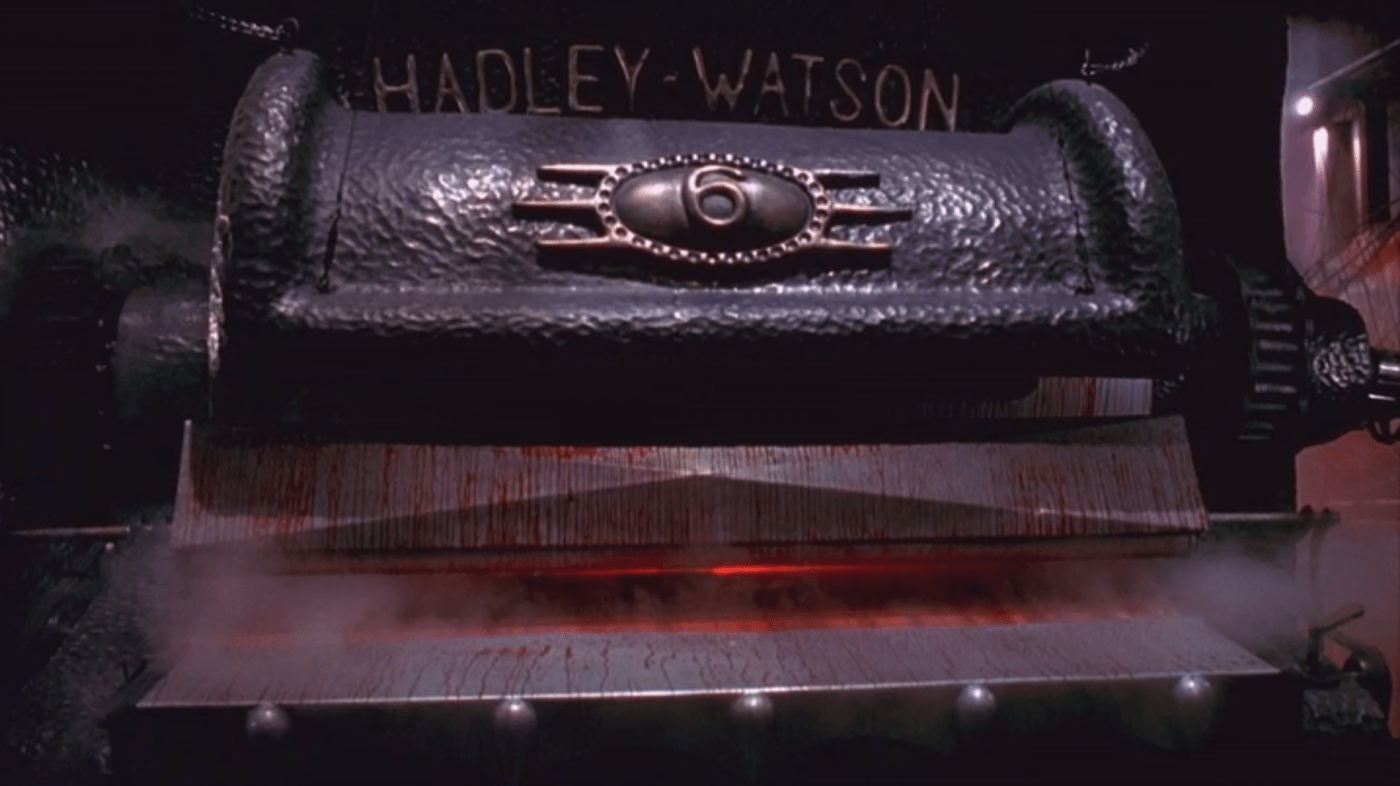
The Mangler represents a rare meeting of three horror icons; director Tobe Hooper (The Texas Chain Saw Massacre and Poltergeist), actor Robert Englund (Freddy Krueger in A Nightmare on Elm Street), and Stephen King (the most commercially successful horror writer of all time). It’s the not the first time any of these people connected with each other. Hooper directed the tv mini-series adaptation King’s classic novel Salem’s Lot and Hooper and Englund worked together on Eaten Alive. Masters of horror have directed King adaptations but few iconic horror actors have been in those movies. It’s the equivalent of having Boris Karloff in an Alfred Hitchcock adaptation of a Shirley Jackson story. While King only wrote the short story The Mangler, just having the three connected together offers a lot of promise. Even if the final product doesn’t fulfill that promise, The Mangler still offers enough to not be too boring.
For anyone not familiar with the source material, The Mangler is about a killer industrial laundry press. A young woman accidentally falls into the laundry press which allows a demon to possess the machine. Naturally it goes on a killing spree, eating/mangling person after person. Office John Hutton begins investigating the murders and concludes it must be possessed. After a botched exorcism, the machine becomes unmoored from the factory and goes off to terrorize the countryside. The short story is deeply absurd and one of King’s better examples of horror comedy. It’s fantastic piece of dramatic irony. Once the cop and his friend determine the machine is possessed and think it’s a minor demon, we get told how easy it is to botch an exorcism ritual if we don’t know the ritual that summoned the demon. It’s then we learn the young woman had belladonna in her system allowing a much more powerful demon to possess the machine. Then hell literally breaks loose. It’s funny stuff.
The film adaptation kind of keeps that dry humor. Tobe Hooper never gets enough credit as a director of dark comedy. The Texas Chainsaw Massacre 2, as gruesome and grotesque as it is, has a strong streak of dark humor throughout. Hooper tunes into the absurdity of a movie about a killer industrial laundry. He turns The Mangler into an occult buddy cop film. Ted Levine’s John Hutton partners with his demonologist brother-in-law Mark to investigate the murders and “accidents” at Blue Ribbon Laundry. Levine’s cop seems dropped in from an entirely different movie which seems to be part of the joke. It’s as if he got stuck in middle of nowhere Maine on his way to be in Seven. Instead he’s stuck in a small town complaining about his pension and investigating killer laundry machines. There’s no reason he should he keep his brother in law around but it’s funny the guy has a modular home in Hutton’s backyard. Also funny, there’s no mention of whatever happened to Hutton’s wife. At one point, there’s a possessed icebox. There’s a character named JJJ Pictureman. You can’t make this stuff up.
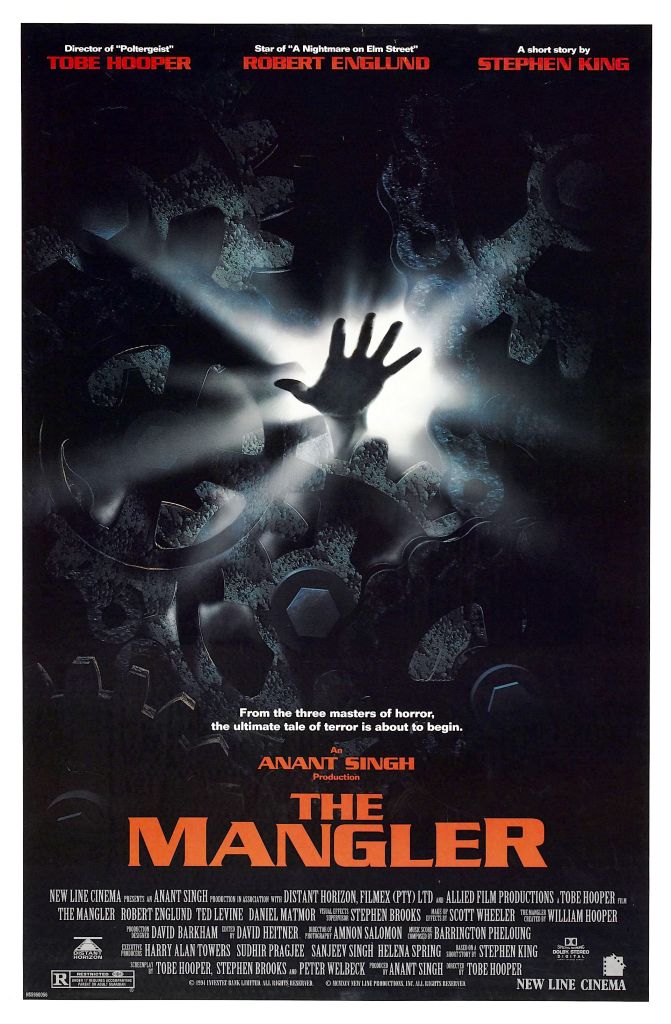
Also because this is a Tobe Hooper movie, there’s a strong streak of social criticism in this movie. As much as it’s movie about a killer laundry press, The Mangler is also a movie about how capitalism chews and spits out the workers. Most of the movie is spent in the warehouse, where it seems like no one ever goes home. Robert Englund’s Bill Gartley lords over his workers. They’re not people but means of production to facilitate his wealth. In fact, he’s a man willing to sacrifice his own family to secure his wealth and power. It’s clear this industrial laundry is the only place of employment in this town. Workers look sweaty and overworked. The first victim of the machine is an elderly woman whose body clearly was destroyed by the years of work in this place. Later a worker has to sever the arm of his foreman after they try to disassemble this killer machine. Much like Tobe Hooper’s films for Cannon Films, there’s a baroque quality to the production design of the film. The industrial laundry looks like a Victorian factory. It’s as if to say that while time has passed outside, maybe the struggles of workers in the twentieth century are still no different than those of the nineteenth century.
The most damning statement on capitalism is the final scene. Levine’s Hutton spends the second half of the movie trying to save Gartley’s factory working niece from being sacrificed to the possessed machine. Like the short story, the machine runs loose after a botched exorcism, chasing both the cop and the niece. After surviving all of this, Hutton goes to visit her at the warehouse. There he sees the worker who tried to save the foreman now the new foreman. He sees the niece now not too dissimilar to her uncle, happy to have taken over and inherited the wealth. The scene is a bit cliche. Still other filmmakers would be content having the niece leave the town, possibly with Hutton, but going off to a happy ending. Here she gets the happy ending but it’s a bleak acknowledgement that some people are willing to sell out others for their own happiness.
As much as parts of this hit really hard, Hooper doesn’t entirely have a handle on all of this. If you go into this expecting a lot of people getting mangled by this machine, you will be very disappointed. There’s exactly three mangler related deaths in this. Two of these seem more in line with the rest of Hooper’s filmography. The last is during the finale when The Mangler goes on a CGI rampage and is a tad disappointing. At least Hooper and editor David Heitner are smart enough to cut frequently so we don’t get a look at the terrible CGI laundry press. Instead, Hooper spends much of the running time on a police procedural trying to investigate what the audience knows is a killer laundry press. As funny as it is to have Ted Levine play a big city cop (complete with raincoat!) in the middle of nowhere it’s such a bizarre choice. Maybe the least surprising thing in this movie is Robert Englund’s cartoonish portrayal of Bill Gartley. The character gets ridiculous old age make up, and unexplained leg braces. You may spend most of the movie wondering how this man gets in out of pants. Anyone who has seen the later A Nightmare on Elm Street films knows that Englund is okay going full ham. Here is a complete pork shoulder of a performance. Englund spends most of the film leering at his workers, and comically sneering at their inability to meet production deadlines. It’s easy to think that Englund and Hooper, who collaborated a total of four times, thought they had a baroque character that fit into the baroque production design. Instead it’s so much of a caricature that it’s hard to take them seriously as a threat. At least his death is spectacular.
The Mangler doesn’t quite live up to the promise of having three icons of horror in one spot. This is a Stephen King story works better on the page because it doesn’t need a murderous CGI laundry press. Robert Englund gives one of his hammiest performances. This is late period Tobe Hooper, the last theatrical wide release for the director. Still a Tobe Hooper film offers interesting production choices and smart social commentary which The Mangler has. It’s not Hooper’s best. Still its hard imaging another director making an anti-capitalist screed out of a horror movie with a killer laundry press.

 Cinema Dual
Leave a comment