
Being Film #4 for Hooptober 2023
Sometimes you sit down to watch a film and you just can’t get into it. Maybe you’ve had a bad day, maybe the tone of the piece rubs raw against whatever it is you’re looking for and you turn away. Sometimes you forget that film altogether. Sometimes, though, a sliver gets under your skin and you can’t help but return for another try. That was the case with writer/director Joko Anwar’s Satan’s Slaves, a re-imagining of the 1980 Indonesian cult horror film, now positioned as a prequel to that same film. It’s an unnerving, frightening take on ghosts and hauntings, with a clear eye for scares and a story that’s all the more engrossing thanks to a fantastic cast. This one definitely got to me in the best way, relishing in its history and culture to present more than just a series of creepy images and jump scares.
THE QUICK SUMMARY: Times are tough for 22-year old Rini and her family: her pop singer mother has been ill for years and the money from her albums have stopped, leaving her, her three younger brothers, her aging grandmother and her mourning father struggling to stay afloat. The old house they live in might have to be sold, but when the mother dies things begin to take a spooky turn. Is she haunting the house? What nefarious plans does the specter hold for youngest son Ian, mute and coming up on his seventh birthday? What isn’t Rini’s father telling his children about a pact made years ago? As the bell continues to ring and more and more violent acts put the family in terror for the lives, it’s up to Rini and her siblings to protect their own against a prophecy they may be too late to stop…

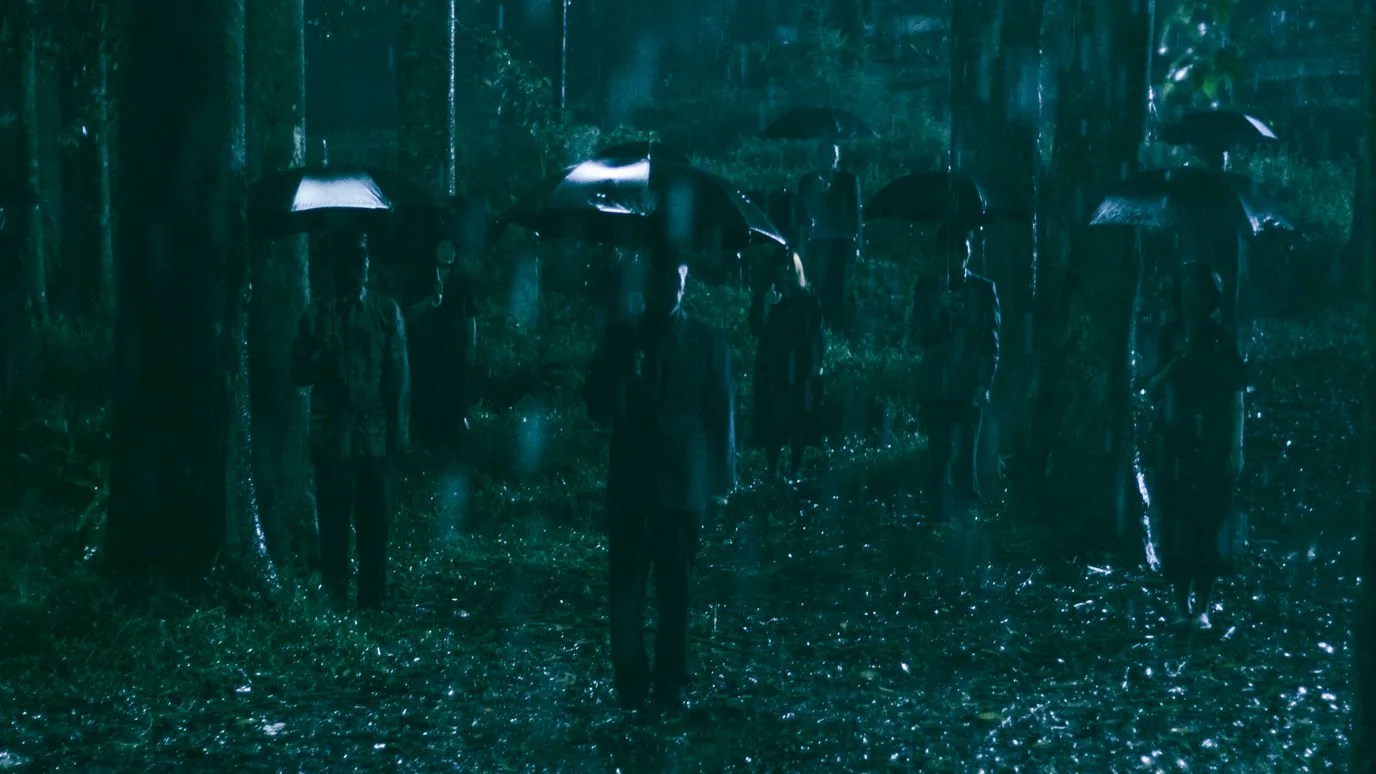
I’ve read complaints that Satan’s Slaves isn’t scary, relying too much on jump scares and not enough gore. When I read criticism like that I have to think those folks aren’t interested in anything other than copious amounts of blood and gore, with no inclination to actually consider a film’s intent. Anwar certainly uses jump scares, but it’s always in service to revealing more about the story he’s creating, and putting his family on edge so that when the big scenes hit, they hit hard. So much of this film plays with you as a viewer, framing shots in such a way that you KNOW something is going to happen, and when it does it deepens the dread that lies at the foundation of the story. The undead flicker in corners, appear briefly as doors close, pop up unexpectedly next to the children’s beds. There’s a brilliant moment when Bondi and Ian, the two youngest children are walking back from going to the bathroom and are afraid of the leering portrait of their deceased mother in the hallway. Bondi attempts to throw a sheet over it, only to have it drape down over an invisible figure, still for a brief moment before rushing towards them. It’s a stellar sequence which, besides being scary, imparts a key piece of information as to what is happening to the family. All of which is to say that yes, the film uses a lot of jump scare tactics. But those tactics pave the way for the final set piece where the dead rise up to claim what belongs to them, and its terrifying in a way that could only be possible thanks to how Anwar framed the rest of the film.
To go more into Satan’s Slaves would be to spoil all the delicious surprises within. I’ll end on a few brief notes. I loved the mythology and story that is ultimately revealed – there are hints of Rosemary’s Baby but viewed through an Islamic lens that I found refreshing after so many Christian-focused films about the Devil and supernatural beings. The acting is top-notch, and Anwar allows all of his cast to really have a part to play instead of being passive pawns in the machinations of plot. There is one scene of violence and viscera, all the more effective for coming out of nowhere and being rare in the film.
Finally there’s the ending that plays over the credits. I was surprised at how well Satan’s Slaves uses music cues but that ending is creepy in a way that reminded me of David Lynch, full of implied menace that basically is compelling me to watch the sequel immediately. If a movie’s ending can do that, then what’s there to complain about?
 Cinema Dual