
Something Like a Filmography takes a (brief) look at the filmography of Akira Kurosawa. Twice a month, Chris and Jon share their impressions of each film, both on its own terms and in terms of Kurosawa’s legacy and its intersection in the Cinema Dual hosts’ lives.
FROM THE BOX: Set in the gorgeous countryside surrounding, this endearing saga follows a Japanese family once torn apart by war and now facing personal demons brought on by contact with American cousins lost long ago. Sachiko Murase is stunning as the aging matriarchof a Nagasaki family that has long lived with a legacy of horror brought on by WWII. But when an older brother she never knew she had resurfacesalong with his Japanese-American descendants she must come to terms with her most deeply held feelings about America and her haunted past.

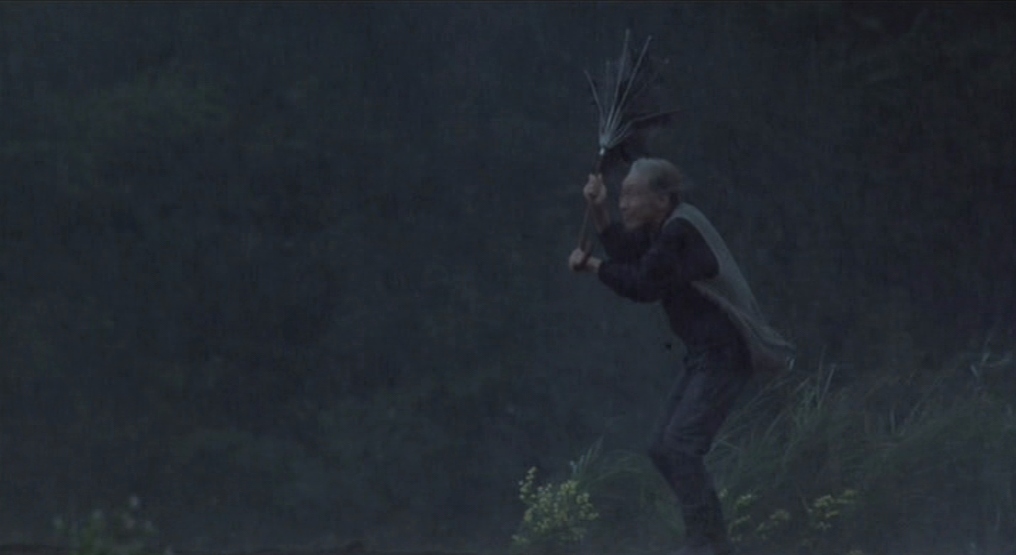
WHAT CHRIS THOUGHT: For decades I was haunted by the image that adorned the DVD (and poster) for Rhapsody in August: the image of an old woman, vainly battling a rampaging storm with nothing but a battered and broken umbrella. The why’s were never known, but that image was burned into my brain until I finally sat down and watched Kurosawa’s penultimate film, a warm, forlorn and – dare I say hopeful? – look at how the horrors of war and the devastation of the dropping of the atomic bomb on Nagasaki haunt and impact multiple generations of a family on both sides of the Pacific. It is the film of a master, no doubt, but it’s also very much the film of a master nearing the end of his days, concerned not with historical perspective but rather his own reflections, searching for the human in frighteningly inhuman events. I was surprised how much it worked for me, and how affecting small moments would play out in this small, tight little film.
First and foremost is the performance of Sachiko Murase as Kane, the elderly grandmother who, over the course of a summer babysitting her grandchildren reveals the deep pain and hurt of losing her beloved husband to the bomb. Mursase is a marvel on screen, at first shriveled and pained as her grandchildren complain about her food and plot to get her to agree to a trip to Hawaii where their parents are visiting her supposed long lost elder brother, now incredibly rich and living with his own family, including his half-American son played by Richard Gere. But over the course of the film she shows a resiliency, grace, and strength that is mirrored in her grandchildren, who learn and show empathy to her pain, and how that sharply contrasts with the view of their parents, who view the atrocity of the war as a hurdle to forming relations with their rich cousins. When events prompt Gere to travel to Japan to visit his newly discovered Aunt the film really blossoms, as Gere surprisingly remains delicate as he shows the same grace and empathy the other adults seem unable to muster themselves.

WHAT JON THOUGHT: By this point in Kurosawa’s career, given his own reputation upheld by his influential Hollywood acolytes, there shouldn’t really be any need for the phrase “hard to find Kurosawa movie” to exist. Even a lot of Kurosawa’s weaker entries will make it into various Criterion collections at some point. This makes Rhapsody in August’s sole physical DVD release from 2003 somewhat notable, or it would be, if not for its seeming discomfiting subject matter (at least for Western audiences). Specifically, the heart of this movie is a protagonist who has lingering resentments about the atomic destruction of Nagasaki at the end of World War II. Sachiko Murase’s Kane even comments that Americans don’t like to be reminded that they dropped the bomb, seemingly presaging the movie’s muted reception.
While Kurosawa deflects perceived American defensiveness by primarily focusing his rage on the idea of war, and the governments that wage them, he does so in service of a movie that sadly, is perfectly fine. The film’s multi-generational concerns and slower pacing nearly evoke Ozu, albeit without Ozu’s style of shot composition. Aside from a couple of notable images, including one of an eye superimposed over a nuclear explosion, there’s not a lot of cinematic wizardry going on here.
Fortunately, Kurosawa’s writing and casting still hold together enough to make a decent watch. The grandchildren’s naivety and distance from the events in question make them ideal recipients of their grandma’s wisdom, and they quickly arrive to the obvious conclusion that “it’s bad that our grandpa died in an atomic blast.” For her part, Murase can equally express her character’s pain alongside the joy of being with her grandkids. When she confusingly runs out into a storm thinking that she can save her husband (who is long dead), it’s heartbreaking. It’s the parents, the generation in between, that seem to have the most trouble navigating family dynamics. In some ways, this is Kurosawa revisiting I Live in Fear, but with enough years and maturity to give space to everyone involved. No one is institutionalized in this movie.
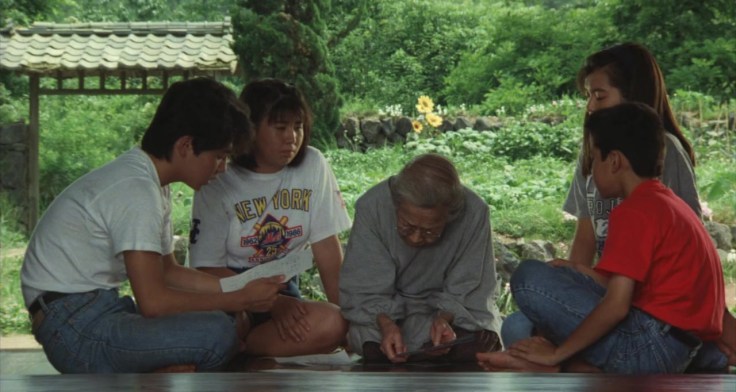
ANYTHING ELSE, CHRIS? There are beautiful moments throughout Rhapsody in August, such as the striking visual as Kane relates what it was like to see the explosion in the sky, cracking open to reveal a gigantic eye, or how Kurosawa frames the view of two mountains again and again in the film, culminating in the reconciliation and reunion between Gere’s Clark and Kane. The grandchildren are uniformly fantastic, and Kurosawa even in his golden years shows a deftness in his choice of actors and his direction, but I’d be lying if I said this was a perfect film. Gere’s presence is only about 20 minutes toward the end of the film, and his sudden disappearance feels a lot like Kurosawa just trying to get to the ending image he had in his mind, which is beautiful…and yet, feels somewhat muddled in what he’s trying to impart with it, especially when paired with the children’s song that is a running theme through the film.
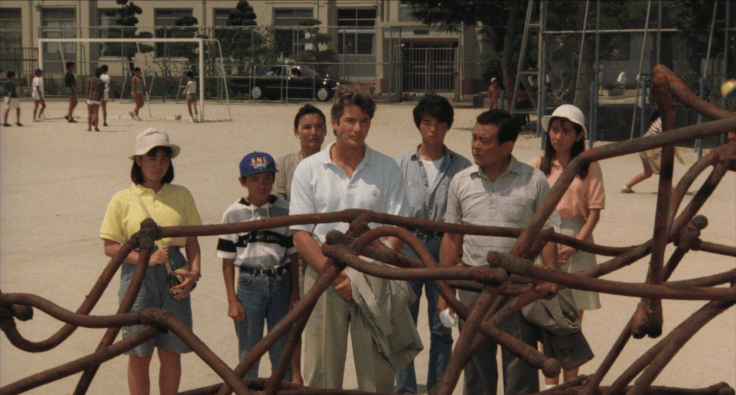
Small issues, to be sure, but enough to knock this off the top tier of his works for me. Still, way better than I Live In Fear, which tried to tackle similar things to lesser success. And scenes like the one at the playground with the memorial of a burned out jungle gym are enough to lift this film up for me. Definitely one I plan to revisit down the road.
ANYTHING ELSE, JON? It must be commented in the wake of Gene Hackman’s passing that yes, of course I would have loved for him to have taken on the role of Clarke that went eventually to Richard Gere. Ultimately though, it worked out fine because Clarke is practically a plot device, who doesn’t show up until 2/3 through the film and has only a few scenes. I find his well meaning and stilted performance here works for his character, an American who doesn’t really know this extended part of the family and only has some basic Japanese phrases down. On that note, his dialogue was some of the few moments of the film where I didn’t need the subtitles, which should underline how fittingly out of place he is here. He does provide an apology to Kane for how he handled their introduction (cue defensive critics wanting to turn this into a larger political statement), but the focus remains on Kane, and what she needs to move on. News of Kane’s brother’s passing in Hawaii forces Clarke to exit the picture almost as quickly as he arrived, and we stay with Kane as she succumbs to the frailty of age.
THE FINAL WORD(S): For Chris and Jon, Rhapsody in August is a thoughtful and moving film that deserves to be remembered.
NEXT TIME: I can’t believe it…it’s the end of the road for our series as we tackle Kurosawa’s final cinematic offering to the world, the story cycle of Madadayo.
 Cinema Dual
Leave a comment