

Something Like a Filmography takes a (brief) look at the filmography of Akira Kurosawa. Twice a month, Chris and Jon share their impressions of each film, both on its own terms and in terms of Kurosawa’s legacy and its intersection in the Cinema Dual hosts’ lives.
FROM THE BOX: Unfolding in a series of eight mythic vignettes, this late work by Akira Kurosawa was inspired by the beloved director’s own nighttime visions, along with stories from Japanese folklore. Interspersed with reflections on the redemptive power of creation, including a richly textured tribute to Vincent van Gogh (who is played by Martin Scorsese), Akira Kurosawa’s Dreams is both a showcase for its maker’s artistry at its most unbridled and a deeply personal lament for a world at the mercy of human ignorance.

WHAT CHRIS THOUGHT: If Ran felt like a final summation, the final word on Kurosawa’s career (life, even?), then Dreams is the soft, delicately inked postscript, a grace note that gently pokes and prods, asking us to to linger at the door as the grand master of cinema allows us into his dreams, to catch a glimpse of the the loves, fears, and preoccupations of a man seeing his own mortality winking back at him.
Comprised of eight vignettes, each dream lives in a logic that captures the eeriness of dreams better than anyone save perhaps David Lynch, and though largely focused on fears or doubts or death are also at once beautiful and so composed as to be paintings. No surprise then that one episode, “Crows” features Akira Terao as the Kurosawa “I”, running through Von Gogh’s paintings, chasing after the man himself (played by Martin Scorsese). Even in the ugliness of an episode like “The Weeping Demon” Kurosawa provides a breathtaking moment as two characters talk in a post-apocalyptic setting that features massive dandelions.
Like any anthology, some vignettes work better than others. When Kurosawa is focusing more on the pure feelings of childhood anxieties (“Sunshine Through The Rain”, “Peach Orchards”) it’s so lovely and striking it feels like the most beautiful thing in the world. When he gets booted down in messages (“Mount Fuji In Red”, “Crows”) things aren’t nearly as successful, even though they’re still beautiful to look at. But just when I was discussing that maybe Ran would have been a great capper to a tremendous career, Dreams proves that not only was there more gas in the tank, but that sometimes there’s nothing like a lovely coda.
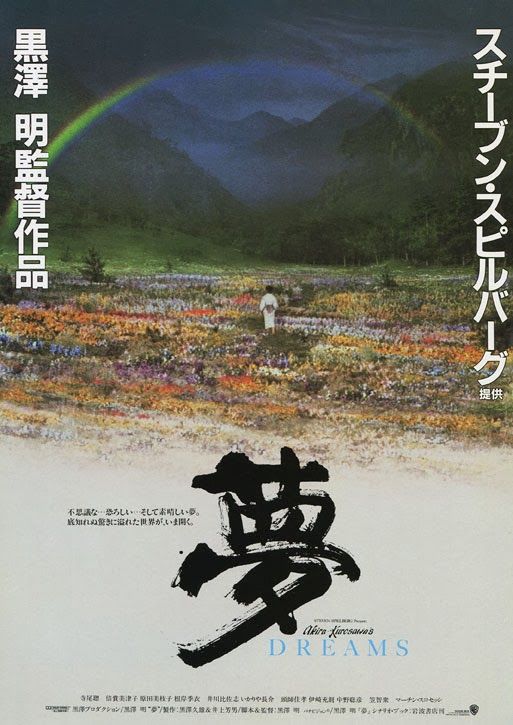
WHAT JON THOUGHT: While the act of relaying a dream to someone is often more interesting to the dreamer than the audience hearing about it, you could certainly do worse by having the dreamer be Akira Kurosawa, backed by Stephen Spielberg and George Lucas. Dreams is an anthology of short pieces, each one depicting a different dream experienced by Kurosawa. I think the movie’s ultimate strength is the production design, with Kurosawa essentially showing off how wonderfully he can compose a color image. Whether it’s a group of costumed actors swaying in the breeze as the ghosts of dead trees, or a series of beautifully recreated Van Gogh paintings, Kurosawa shows that even after a career with several masterpieces including Ran, he still has ideas that need to be seen on screen.
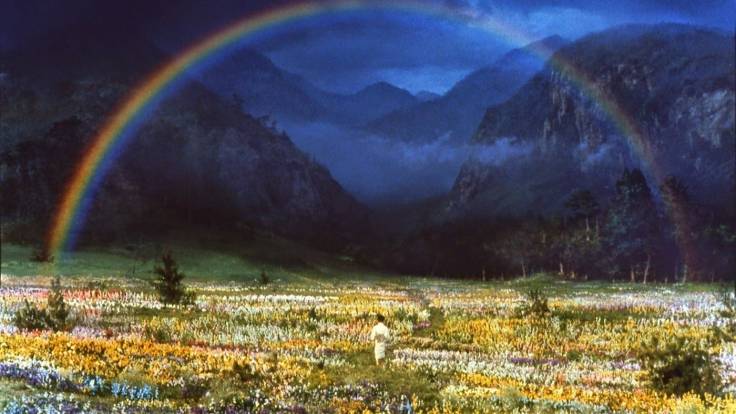
The stories themselves however, are slightly more of a mixed bag, with some succeeding more than others. The film’s iconic rainbow shot comes at the end of the first piece “Sunshine Through The Rain”, about a young boy who tries to atone for sneakily observing a magical fox wedding that is mostly fine. Despite an amazing performance by returning actor Mieko Harada, “The Blizzard” doesn’t have much else going on for it, especially when it’s shown that despite the climbers’ near death experience, they were barely outside their camp. And while I appreciate the ambition of “Mount Fuji in Red”, the dialogue is heavy handed in a way that dampens the message.
The remaining dreams however, mostly make up for it. “The Peach Orchard” and “The Village of the Water Mills” both beautifully meditate on Kurosawa’s environmental and societal concerns, and where “Mount Fuji in Red” doesn’t quite land, “The Weeping Demon” quite successfully shows the horrors on the other side of those issues. “Crows” is a sweet and simple tribute to Van Gogh. My personal favorite is “The Tunnel”, which sees a Japanese officer be confronted by the spirits of the platoon that died under his command in the war. It’s a harrowing short tale of survivor’s guilt, brilliantly rendered.

ANYTHING ELSE, CHRIS? Although it’s not my favorite episode, “Sunshine In The Rain” just so beautifully captures that weird blend of chaos and meaning you only find in dreams. The weird cuts in time, the massive scale of the doors as they’re shut Kurosawa’s child stand-in, the inexplicable logic having to commit suicide for watching a kitsune wedding…it makes no sense and so makes perfect sense. And despite the able assist from ILM (a gift from George Lucas to have the company handle the effects at cost to keep the budget down), one of my favorite effects in Dreams is the makeup used to create the kitsune – it’s subtle and striking, effortless in convey the magic of the folklore.
A few more stand out: the incredible makeup of the dead soldiers in “The Tunnel”, the icy blues and slow motion of the ever-slowing mountaineers in “The Blizzard”, and of course the incredible landscape brought to life in “The Weeping Demon”. But my two favorite episodes have practically zero effects in them. The stunning power of “The Peach Orchard” is in that framing of the little boy at the bottom of the hill, as the ghosts of the peach trees give him the gift of one final look at the orchard in full blossom through an exquisite dance that transforms in the trees. And finally “The Village Of The Water Mills” which shows Kurosawa’s “I” arriving at a village with no name, where technology and convenience has been eschewed for the natural beauty of life, and a funeral procession acts as a loving moment of reflection, and perhaps a peace being found in the specter of our own death.
ANYTHING ELSE, JON? While Akira Terao as “I” the Kurosawa stand-in is often left to observe the proceedings of the various dreams, I think he acquits himself admirably as the closest thing to a throughline in the film. For smaller roles, the younger I played by Mitsunori Isaki in “The Peach Orchard” is quite moving in his sadness over the loss of the trees. Both Yoshitaka Zushi and Chishu Ryu offer their own separate compelling moments in their scenes. And I find Chosuke Ikariya’s weeping demon to be fascinating.
Finally, I would have loved to have seen Kurosawa follow up on these themes and production styles in full length features. Even as much as I didn’t like “Mount Fuji in Red”, it did give a rare glimpse of Kurosawa shooting in color in early 90’s Japan. With the backing of major studios, I would absolutely watch a Kurosawa movie set in contemporary Japan.
THE FINAL WORD(S): For Chris, Dreams is a wonderful and delicate postscript from a cinematic giant. For Jon, Dreams is a gorgeous glimpse into the mind of one of cinema’s great masters.
NEXT TIME: We hit our penultimate film in the series, and are ready to marvel at what the master can do with…Richard Gere? It may only be March, but we’ll be back for a Rhapsody in August.
 Cinema Dual
Leave a comment