
Something Like a Filmography takes a (brief) look at the filmography of Akira Kurosawa. Twice a month, Chris and Jon share their impressions of each film, both on its own terms and in terms of Kurosawa’s legacy and its intersection in the Cinema Dual hosts’ lives.
FROM THE BOX: With Ran, legendary director Akira Kurosawa reimagines Shakespeare’s King Lear as a singular historical epic set in sixteenth-century Japan. Majestic in scope, the film is Kurosawa’s late-life masterpiece, a profound examination of the folly of war and the crumbling of one family under the weight of betrayal, greed, and the insatiable thirst for power.

WHAT CHRIS THOUGHT: From the opening moments of a boar hunt amidst lush green fields and mountains, to the tragic battle at the film’s climax, Ran feels enormous, Kurosawa’s largest and more epic canvas to date. Using the bones of King Lear to frame his larger story, Kurosawa boldly paints perhaps the largest portrait of his own life yet, mixing in his own mortality and conflicted feeling of his legacy with the frankly astonishing performance of Tatsuya Nakadai as the doomed by his own ego Lord Hidetora, the patriarch of the Ichimonji clan. We can talk about the use of color, we can talk about the incredible use of sound (and especially silence), or the stunning production design and costuming, and makeup. But first and foremost is Nakadai’s performance, which after a string of strong performances, from the pistol wielding Unosuke in Yojimbo to the chief inspector in High and Low and his towering double performance in Kagemusha elevates him to the top echelon of Kurosawa’s stable of actors.
There re so many incredible choices made throughout Ran, taking everything Kurosawa had learned as a filmmaker and putting what feels like his final statements on the. With only his fourth color film he masters the form, taking a more naturalistic approach to his cinematography but making the colors stand out even more than Kagemusha, both aesthetically and thematically. His action set pieces are among his very best, visceral and striking and massive in scale. Using Shakespeare’s Lear as the bones to hold the story together keeps a solid frame work for Kurosawa to adhere to, keeping him from running too far astray – something that could be said about his previous film. And his use of sound and silence is genius: the incredible battle at the abandoned Third Castle is haunting as the sound drops, leaving Tōru Takemitsu’s lush score to stand in for the roars of violence and carnage war -the only things Hidetora has really even known – turned against him.

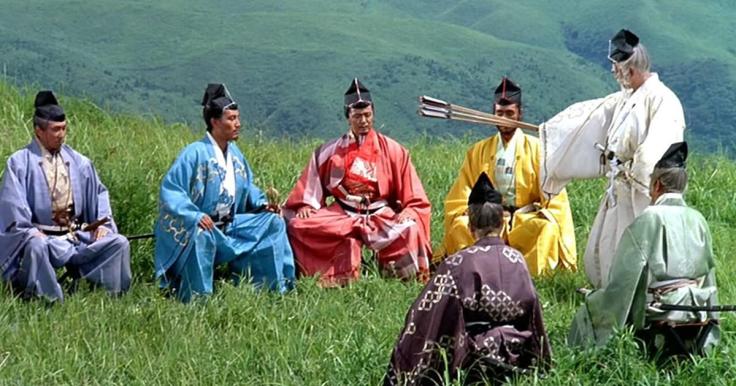
WHAT JON THOUGHT: Of the plethora of good decisions made for this film, among the best is the use of color in this movie. The green mountains in the beginning make the primary colors of the sons’ costumes pop to such an extent that in the scenic wide shots, you don’t lose track of where people are. Kurosawa gives his audience a visual feast that not only delights but instructs as well, as you follow characters not only by their performances but also by the color coding of each faction. This holds true even in the film’s centerpiece, the apocalyptic siege of the Third Castle. As the sky is blotted out (Kurosawa still using weather to tell the story), you can still follow the yellow and red flags of Taro and Jiro’s armies.
If Kurosawa is bringing his biggest and arguably best to this movie, then credit also needs to be extended to his actors, all of whom rise to the occasion of having to make a samurai King Lear. Tatsuya Nakadai expertly conveys Hitdeora’s descent from powerful warlord to raving outcast, having to face the horrifying consequences of his actions. I also both fully empathize with Akira Terao’s Taro (the oldest son who is chafing that his dad’s retirement doesn’t seem to be sticking) and Daisuke Ryu’s Saburo (the youngest son whose loud mouth gets him exiled and yet ultimately is the only one to defend his dad). If Jinpachi Nezu as Jiro the middlest brother doesn’t turn as many heads, it’s only really because plot reasons require him to be unremarkably bad. Ultimately though, the eventual reveal of Mieko Harada’s Lady Kaede as having orchestrated this family’s terrible downfall as revenge for the destruction of her own family may end up taking it for me. It’s not a significant chunk of screen time but it certainly is a memorable one.
ANYTHING ELSE, CHRIS? Despite my 5-star rating, there are very, very minor squabbles to be had with Ran. As incredible as Nakadai and Mieko Harada as Lady Kaede (we’ll get to her in a moment) are in the film, the three sons are practically an afterthought. Eldest son Taro is basically a cardboard cutout, while second son Jiro is a cuckolded generic villain; meanwhile sweet baby brother Saburo is kept off screen for so long his re-appearance and reconciliation with his father doesn’t have quite the impact it should have, despite the slam bang sequence Kurosawa constructs for them at the film’s last act.
I say it’s a minor quibble, because all of that leftover space is taken up by the stupendous performance of Harada as Lady Kaede, the true villain and potentially one of Kurosawa’s greatest antagonists ever put to film. I suspect Kurosawa knew exactly what he was doing in his casting, because notably both Kaede and Hidetora are the only two characters in Ran that are made up in the more traditional and theatrical Noh style, while everyone else is more naturally clothed. That goes to their acting as well, and the more I think about as I write this the more I come to realize those thinner, broad stroke characterizations of everyone else allows Kurosawa the space for his leads to really stand out visually as well as in their performance. I will forever be haunted by the scene of Hidetora stumbling through a burning castle, his empty scabbard trailing him like a dog, and the intense sequence of Lady Kaede slowly unwrapping a white package, both terrified and delighted at what she expects to find…
ANYTHING ELSE, JON? Prior to this series, I had seen most of Kurosawa’s filmography at least once, with only a few exceptions. Some I had seen a couple of times, but I have come to realize that Ran is the only Kurosawa movie, possibly the only non-English movie that I have seen enough times to have completely internalized. Chris has correctly pointed out to me that this can affect how I see some other Kurosawa films (apologies to Kagemusha), but I think there’s more going on than just that. I keep coming back to Ran because of its amazing visuals, huge scale and excellent performances. Kurosawa has shown himself to be an excellent filmmaker across different styles, genres, and budgets. Ran is simply the film of his I like most.

THE FINAL WORD(S): For Chris, Ran represents the final summation of Kurosawa as a director, a masterclass in everything that came before, polished and imbued with the loving final touch of a man almost ready to put down his pen. Jon, in a career replete with pinnacles, Ran might be Kurosawa’s highest.
NEXT TIME: We step into lush fantasy and Martin Scorsese…acting? Yup, time to visit the vibrant anthology of Kurosawa’s Dreams.
 Cinema Dual
Leave a comment