

Something Like a Filmography takes a (brief) look at the filmography of Akira Kurosawa. Twice a month, Chris and Jon share their impressions of each film, both on its own terms and in terms of Kurosawa’s legacy and its intersection in the Cinema Dual hosts’ lives.
FROM THE BOX: By turns tragic and transcendent, Akira Kurosawa’s film follows the daily lives of a group of people barely scraping by in a slum on the outskirts of Tokyo. Yet as desperate as their circumstances are, each of them—the homeless father and son envisioning their dream house; the young woman abused by her uncle; the boy who imagines himself a trolley conductor—finds reasons to carry on. The unforgettable Dodes’ka-den was made at a tumultuous moment in Kurosawa’s life. And all of his hopes, fears, and artistic passion are on fervent display in this, his gloriously shot first color film.

WHAT CHRIS THOUGHT: Kurosawa abandons the 60s, Mifune, widescreen and apparently a cohesive narrative for…a vague and depressing color film that juggles various vignettes about a community living in poverty that ultimately has little to say except I guess keep your chin up? Things could be worse so why not pretend to drive a trolly car? I don’t know – Dodes’ka-den doesn’t feel like it has anything to say, and treads similar ground to a lot of Kurosawa’s other films. There are a few interesting things at play here technically besides the obvious switch to color: working with Takao Saito Kurosawa explores zooms in a significant way for the first time, and the production design of the slum and how its gritty environment is juxtaposed with the gleaming neon reflected in the windshields of the cars in the city is a nice touch.
But ultimately there’s more that doesn’t work than does in Dodes’ka-den. Beyond losing Mifune after Red Beard, this is the first film in forever where Masaru Sato isn’t doing the score, and the result with Tōru Takemitsu reeks of schmaltz and tepid Hollywood studio fare. A perhaps unfair comparison, but coupled with the depressing subject matter it didn’t work for me at all. Nor did the advancement of adult subject matter in his work: the sexuality is amped up from the already intense and vibrant Red Beard with wife swapping, a side story about a woman who sleeps around and has kids with seemingly everyone in the community except her husband, and a truly gross and creepy rape between a young woman and her uncle that ends in violence and doesn’t do anything other than show Kurosawa could tackle more “mature” themes, except in this context they simply don’t work for me.

WHAT JON THOUGHT: We have not had a need to discuss the use of color in Kurosawa’s work to date, aside from the shot of pink smoke in High and Low, as all of Kurosawa’s films up until this point have been shot in black and white, even past the point of necessity. In collaboration with cinematographer Takao Saito (who would go on to shoot most of Kurosawa’s movies going forward), the decision was made to shoot Dodes’ka-den in color, even going as far as to sacrifice the widescreen aspect ratios he’d made such beautiful use of because he didn’t like how those lenses showed color.
Without finding any stated reason by Kurosawa for wanting to branch out, nevertheless I think the results speak for themselves. The derelict world inhabited by the characters of the film seems bright and colorful, even as you never fully escape the immanent humanity that is depicted. The delusions and fantasies experienced in the film benefit from the addition of color, especially the boy’s house covered in train drawings and the beggar’s visions of a dream house.
It also seemingly provides cover for some Kurosawa’s bleakest storytelling yet, between the death of the beggar’s son to the young woman Katsuko being raped by her uncle and her subsequently stabbing someone else. These moments shake, but ultimately don’t upend Kurosawa’s storytelling formula for these kinds of movies. The main issue is that Kurosawa doesn’t really advance them either. There’s not much here, other than the use of color, that you won’t find in his earlier, arguably better movies. As an exercise, it works fine. Beyond that, I don’t see a need to revisit.
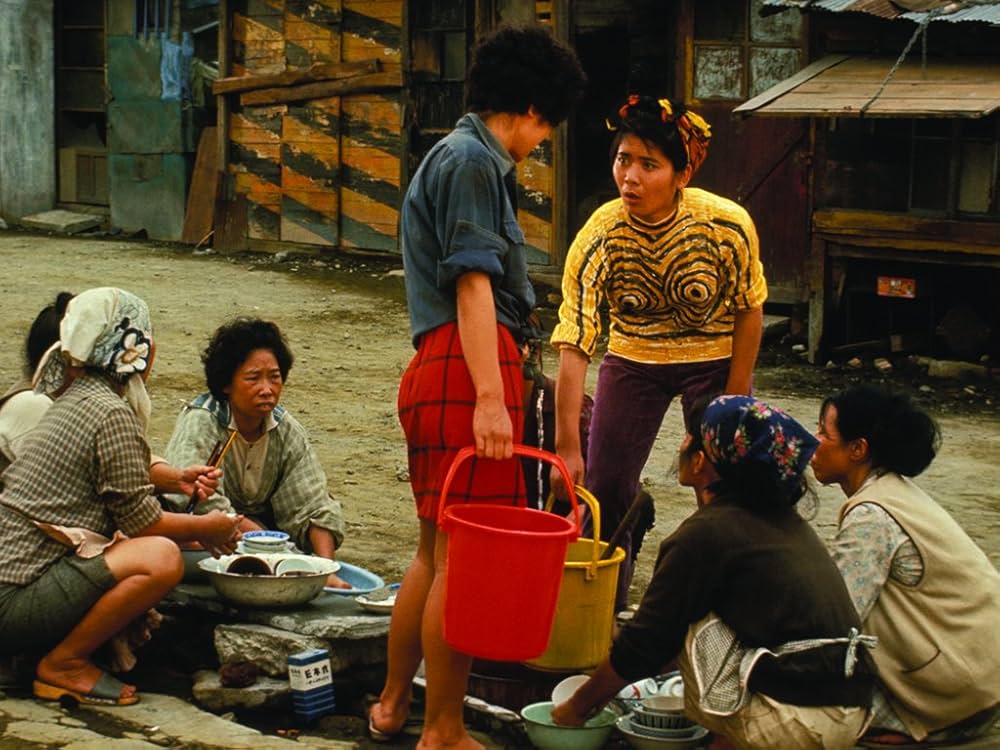
ANYTHING ELSE, CHRIS? I purposely didn’t talk about the color aspect of the film above, because my distaste for Dodes’ka-den aside, Kurosawa’s embrace of color is the one thing that DOES work. He uses it in much the same way as he did in his painting, and the striking yellows and oranges reminded me of his impressionistic art, especially in the more fanciful sections of the beggar and his child building their dream house in their imagination, and how the skies take on bright and vibrant hues. I also appreciate Kurosawa’s leap into fantasy with both the sections with the beggar and with the young Rokuchan, who despite the audience never seeing the imaginary trolly can hear every clink of metal, release of steam, and clickety-clack the film derives its name from.
ANYTHING ELSE, JON? Without walking back my earlier statement, I will say that I appreciate the effect of Rokuchan’s imaginary train adventures weaving through the various plots. We don’t see what he sees, as in the beggar’s dream house, and so are kept at a distance. Likewise, in that first sequence with Rokuchan, the other kids in the neighborhood consistently mock him for his obsessions with things that aren’t there. By the film’s end however, every other story we follow comes off just as depressing if not more so. In comparison, maybe Rokuchan’s trains don’t seem so bleak.
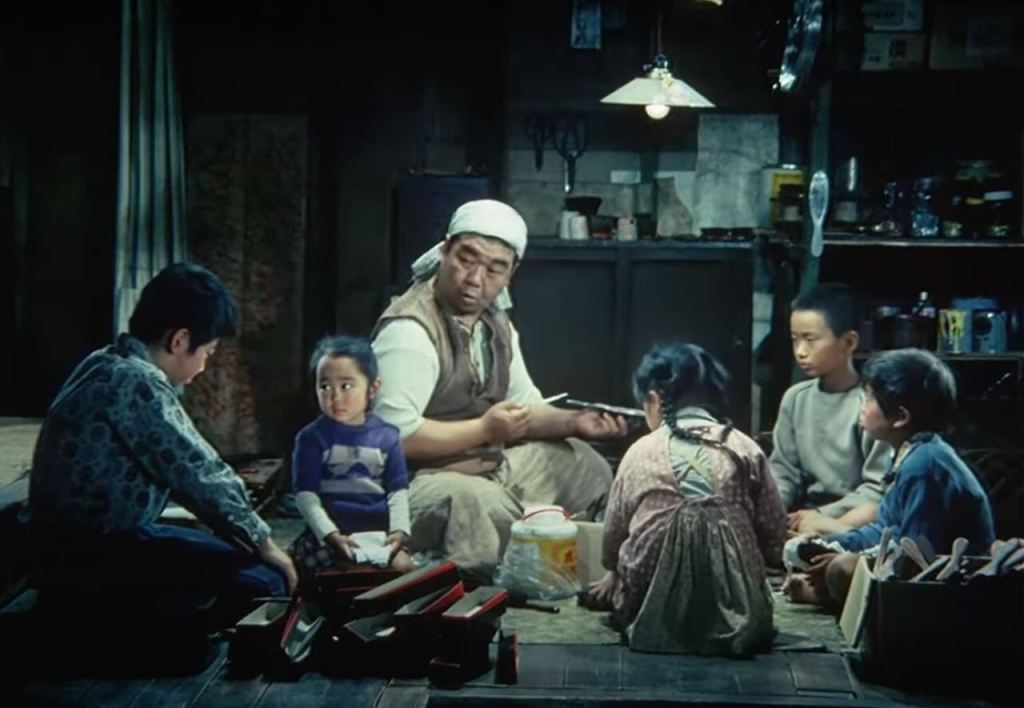
THE FINAL WORD(S): For Chris, Dodes’ka-den gets mired in a lack of focus and direction, but shows Kurosawa still willing to embrace the new. For Jon, Dodes’ka-den gets Kurosawa to adjust to a new medium, but struggles to go beyond the parameters of a mere exercise.
NEXT TIME: It’s fallow times, as there’s just one more film left for Kurosawa in the 70s, the wintery Russian exploration of man and nature in Dersu Uzala.
 Cinema Dual