
Something Like a Filmography takes a (brief) look at the filmography of Akira Kurosawa. Twice a month, Chris and Jon share their impressions of each film, both on its own terms and in terms of Kurosawa’s legacy and its intersection in the Cinema Dual hosts’ lives.
FROM THE BOX: A grand-scale adventure as only Akira Kurosawa could make one, The Hidden Fortress stars the inimitable Toshiro Mifune as a general charged with guarding his defeated clan’s princess (a fierce Misa Uehara) as the two smuggle royal treasure across hostile territory. Accompanying them are a pair of bumbling, conniving peasants who may or may not be their friends. This rip-roaring ride is among the director’s most beloved films and was a primary influence on George Lucas’s Star Wars. The Hidden Fortress delivers Kurosawa’s trademark deft blend of wry humor, breathtaking action, and compassionate humanity.

WHAT CHRIS THOUGHT: This may be the low-grade fever and body chills talking (I made the rather dumb choice to get two vaccinations at once and this old man body is not dealing, lol), but I did not know how much I needed a Kurosawa whose only preoccupation is entertaining the hell out of us. And in gorgeous widescreen, to boot. The Hidden Fortress immediately makes use of that new real estate in one of the master’s most striking openings. As Tahei and Matashichi are startled by the samurai dying right behind them, we also see what I think might be the most graphic depiction of blood in a Kurosawa film to date, although my mind might be playing tricks. You can see Kurosawa and his DP Ichio Yamazaki play with the format, whether its the sumptuous filming of the incredible locations (I think this might be Kurosawa’s most visually dazzling film), at one point anchoring the two peasants at the edges of the frame with the eponymous fortress in the center, only to dance as Tahei leaps to the side to now focus on our protagonists.
The deep focus, the blocking and incredible crane shots that make up the incredible spear dual…this film is a visual wonder from start to finish, only occasionally getting bogged down in a little too much repetition. At just under two and a half hours, I think you could trim a little fat off here and tighten up the more action packed moments. Delightful as it is, I came away realizing that actually there’s not a whole lot of action for an adventure film like The Hidden Fortress wants to be.
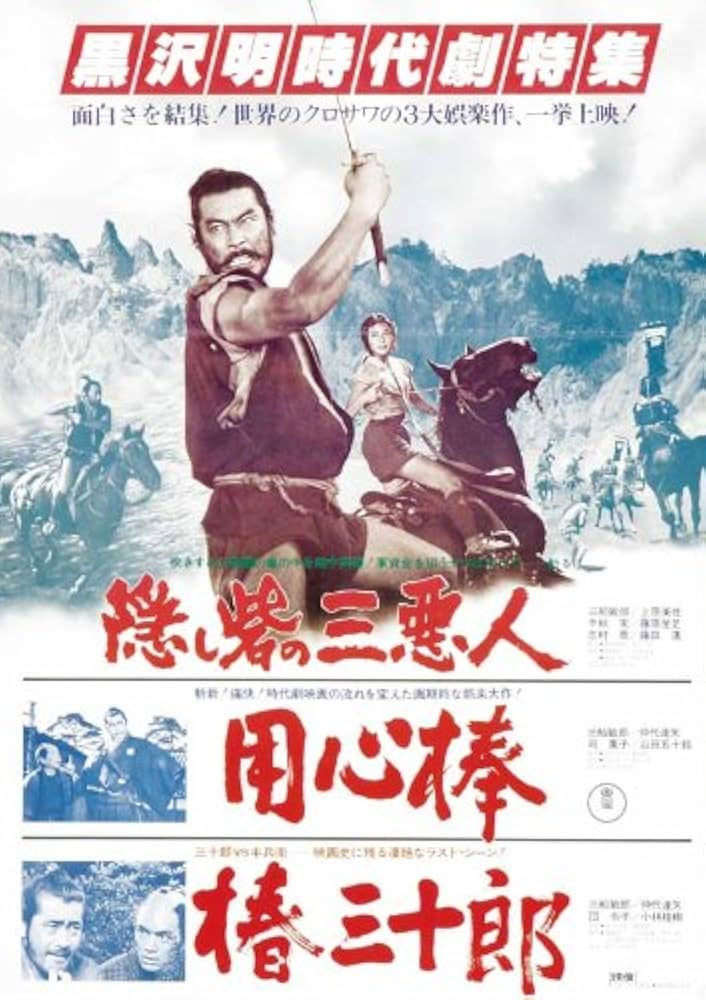
WHAT JON THOUGHT: In our recent discussions of Kurosawa’s adaptation of The Lower Depths, one of our chief criticisms is that Kurosawa is so heavy handed in his deployment of the film’s themes that is can be exhausting to watch. The Hidden Fortress, not lacking in social commentary, does not similarly suffer this same problem. Sure, Tahei and Matashichi are feckless wretches, whose stubborn refusal to develop any moral character may turn out to be more trouble than they’re worth. General Rokurōta in turn shows streaks of cruelty in his treatment of the two peasants. But the cruelty doesn’t sink the movie, and in fact The Hidden Fortress remains an incredibly fun adventure movie.
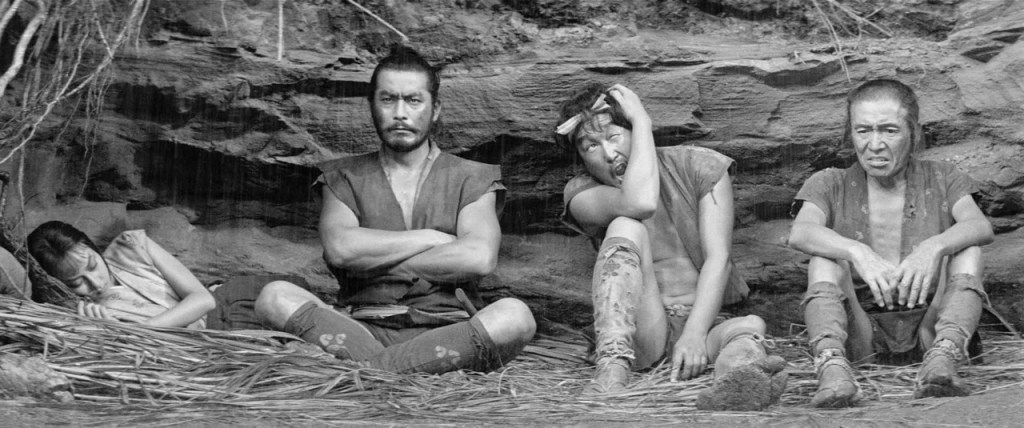
If the movie has a heart, it is Misa Uehara’s Princess Yuki, who needs to smuggle herself and the gold to safety in order to rebuild her destroyed kingdom. However trapped she may be by her station and gender, she nonetheless has scathing critiques of the hierarchy that ensnares them all. She proves more than a match for Tahei and Matashichi when they get too close, and in what seems to be a continuing trend in this series, is able to stand toe to toe with Toshiro Mifune’s Rokurōta. Most of the character growth in the film, from Rokurōta to rival general Tadokoro, comes down to the influence of Princess Yuki.
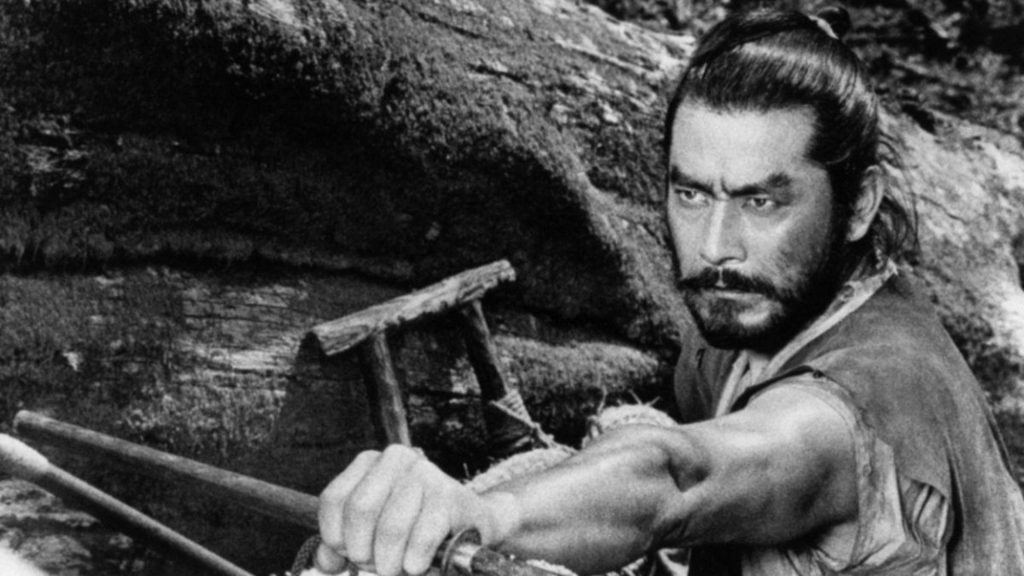
ANYTHING ELSE, CHRIS? I’m still thinking about how beautiful this film looks…but I can’t let pass the incredible score by Masaru Cato. The scene where Mifune’s General Rokurōta jumps on a horse to chase down some soldiers going back to report on their whereabouts and once that score kicks it with it, I legit cried out loud “Motherfuckin’ Toshiro MIFUNE!” Similar to the wonderful shot during the dual where Mifune, facing the camera, twirls his spear in a deadly attack, the camera frantically backing away. It’s just gorgeous, and shows not only Kurosawa’s quick adaption of the new format, but also shows his actors – especially Mifune – adapted as well.
And speaking of the actors, it’s no coincidence I’m back to loving a Kurosawa film that also happens to have the return of Takashi Shimura, though relegated to a brief cameo more than anything else. That’s more than made up by the presence of Misa Uehara as Princess Yuki, whose fiery passion exudes from every pore despite her playing mute for most of the film. As the peasants Minoru Chiaki and Kamatari Fujiwara are equally fantastic, holding their own against the entire film and stubbornly refusing to grow in any way over the course of the film. I think that’s intentional, Kurosawa stooping just a little bit to what was happening in the west and creating something that didn’t so obsessively pick at the human character.
ANYTHING ELSE, JON? Kurosawa’s career spanned a long enough time period for him to witness and integrate various new technologies into his artistic repertoire, and for The Hidden Fortress, that was the widescreen Tohoscope format. It cannot be understated how gorgeous this movie looks, with Kurosawa utilizing every inch of screen that he can get his hands on. No wonder directors like Sergio Leone would be inspired by this period of Kurosawa when making their spaghetti westerns. The landscapes are just gorgeous. Even the duel between Rokurōta and Tadakoro uses spears so that Kurosawa can keep the actors far apart with the extra space afforded by the new format. The wide shot of the open landscape when the movie’s big escape happens is so exhilarating.
THE FINAL WORD(S): For both Chris and Jon, The Hidden Fortress is an eminently re-watchable good time, and showcases Kurosawa’s ability to incorporate new tools into his already skillset.
NEXT TIME: We hit the groovin’ 60s and Kurosawa has another go at Shakespeare in the cutthroat world of corporate Japan in The Bad Sleep Well.
 Cinema Dual
Leave a comment