

Something Like a Filmography takes a (brief) look at the filmography of Akira Kurosawa. Twice a month, Chris and Jon share their impressions of each film, both on its own terms and in terms of Kurosawa’s legacy and its intersection in the Cinema Dual hosts’ lives.
FROM THE BOX: Kurosawa transforms Maxim Gorky’s classic proletariat play The Lower Depths, remaining faithful to the original with its focus on the conflict between illusion and reality—a theme he would return to over and over again. Residents of a rundown boardinghouse in 19th-century Japan, including a mysterious old man and an aging actor, get drawn into a love triangle that turns violent. When amoral thief Sutekichi breaks off his affair with landlady Osugi to romance her younger sister, Okayo, Osugi extracts her revenge by revealing her infidelity to her jealous husband.

WHAT CHRIS THOUGHT: I can admire Kurosawa’s balance of alternating larger, epic films with smaller, more “personal” movies (though I’d argue all his films have the earmark of focusing on the personal, even when you have seven samurai battling a bandit horde), and though those smaller movies often leave me wanting, The Lower Depths – at least visually – brings the goods. Based on Gorky’s play, Kurosawa really gets into the dirt and corners of his single location hovel, making a cinematic feast of the story of a motley crew of unfortunates in a boarding house, the performances we put on for our own benefit, and how each of the characters failings and corruption come to fore. It’s to date possibly Kurosawa’s more depressed, nihilistic film, with no single character focus; instead an ensemble crew (though I miss for the first time Takashi Shimura) play almost nameless archetypes that play out their passions across a timespan of a few days and are left largely as they were before, though bereft of more than a few souls.
I’ll admit it took a few sittings to get through The Lower Depths: I think this was one that was just so cynical and dispassionate about its characters it took a lot out of me emotionally. Kurosawa found humor in Gorky’s original play and I think was aiming for a sort of gallows humor here. Maybe for its time it was successful, but I found the tone almost punishing when pressed against the stresses of my actual life. You can’t help but bring your entire experience every time you sit down in front of a film, and for me I found I could really admire a lot of what I was seeing, but watching it was depressing more than I really wanted from this film – or any film – at the time.

WHAT JON THOUGHT: It is remarkable to me that Kurosawa, already having proven he could adapt famous plays onto the big screen without needing the trappings of its source material, would then choose to fully embrace those same trappings on his next adaptation. The Lower Depths takes mostly takes place in and around one single location, with long extended scenes of well rehearsed actors performing their lines, leaving and entering the static scene as the script demands. There is no pulse pounding action sequences like the end of Throne of Blood to be found here.
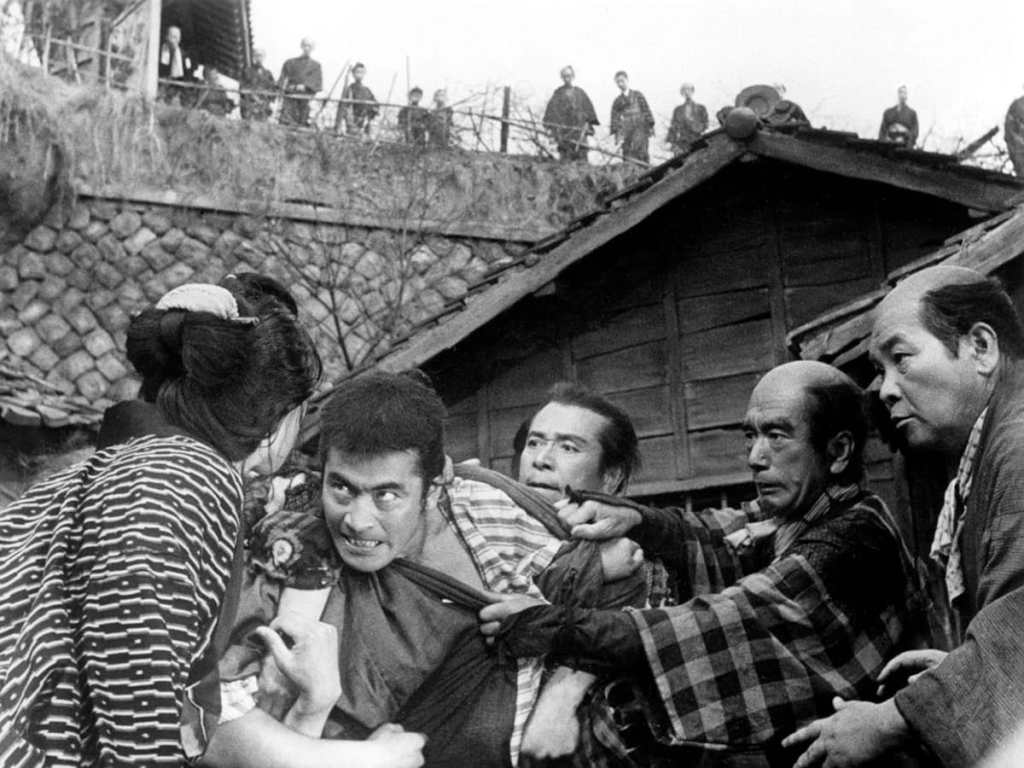
Lest this be construed as a complaint however, this movie has a lot going for it. Cinematographer Kazuo Yamasaki compensates for largely static camera shots by absolutely packing every inch of the frame at practically every moment. Scenes with multiple characters in close proximity to each other are blocked in foreground, background, and even occasionally on top of each other. The few scenes we get outside of the residence are always framed from a low angle to emphasize how high up the upper class is above our characters, in multiple senses.
The longer takes also allow the actors to really lean into their scenes without having to worry as much about it being chopped up in the edit. While not as central in this movie, it is good to see Toshiro Mifune and Isuzu Yamada return from Throne of Blood. We see different sides of both actors from the last movie, with Mifune being more jovial and Yamada getting to play the cackling antagonist, which she does quite well. The whole ensemble is quite good, with each smaller part contributing to the larger whole.

ANYTHING ELSE, CHRIS? Some stream of consciousness thoughts: love the opening shot of the folks talking offscreen, keeping you off balance until they appear to dump trash directly onto the dilapidated boarding house that will serve as the film’s setting…Kurosawa, working with cinematographer Kazuo Yamasaki construct some gorgeous blocking in their shots, particularly when it comes to outlining the boundaries inside the house, and the sublime shot of the group outside ruminating on their fortunes…still slightly distanced by the fact the players – even Mifune and Yamada – are more archetypes and broad caricatures rather than flesh and blood people. Maybe that was the intent, but I can’t deny it kept me at arm’s length from really connecting with anyone…kudos to a distinctly downbeat ending, but in truth the ending is a little protracted: we could have ended at least 15 minutes earlier; not sure what the death of the actor really brings to the film, and why we had to wait that much longer for it.
Oh, and Mifune’s legs are a wonder…that man has magnificent leg acting.
ANYTHING ELSE, JON? I agree with Chris that the film’s denouement could have been considerably shorter without losing the punch of the final line given by the gambler straight to the camera about how the actor’s suicide ruined a good party. Similarly, I also took in a couple viewings of the film, explicitly looking for the film’s themes of self deception and nihilism. From the opening conversations, it’s clear that these elements are of clear importance to Kurosawa and his appreciation of the source material, and there are moments like the ending where it shines through. Unfortunately that does leave most of the rest of the movie for the audience to think about better Kurosawa movies wherein people lie to themselves.
THE FINAL WORD(S): For Chris, The Lower Depths is a marvel of construction and directing, taking a less trod path that didn’t really land (though I’d definitely give this a re-watch when I’m in a better frame of mind)…For Jon, the movie is a surprisingly bleak take on familiar thematic material to Kurosawa that, despite its considerable production, doesn’t succeed as much as it should.
NEXT TIME: We sail for high adventure and meet a couple of scoundrels who will prove to be fodder for some obscure space war movie in The Hidden Fortress.
 Cinema Dual
Leave a comment