
Something Like a Filmography takes a (brief) look at the filmography of Akira Kurosawa. Twice a month, Chris and Jon share their impressions of each film, both on its own terms and in terms of Kurosawa’s legacy and its intersection in the Cinema Dual hosts’ lives.
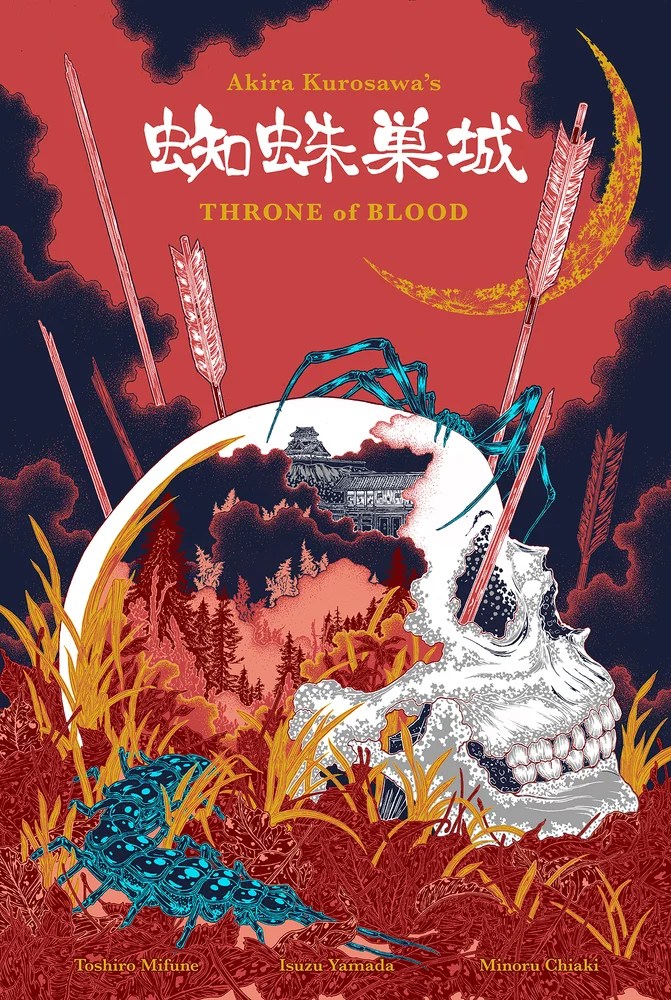
FROM THE BOX: A vivid, visceral Macbeth adaptation, Throne of Blood, directed by Akira Kurosawa, sets Shakespeare’s definitive tale of ambition and duplicity in a ghostly, fog-enshrouded landscape in feudal Japan. As a hardened warrior who rises savagely to power, Toshiro Mifune gives a remarkable, animalistic performance, as does Isuzu Yamada as his ruthless wife. Throne of Blood fuses classical Western tragedy with formal elements taken from Noh theater to create an unforgettable cinematic experience.
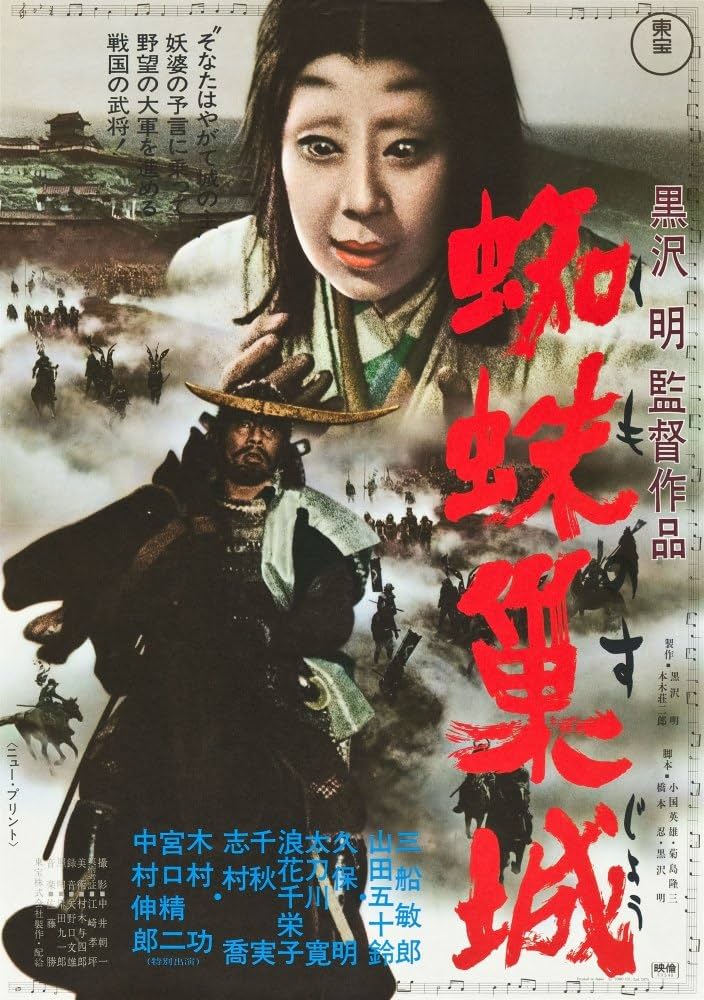
WHAT CHRIS THOUGHT: Feudal Japan works perfectly as a setting for Kurosawa’s adaption of Macbeth, the drama heightened by Throne of Blood’s use of Noh theatrics to elicit a surreal, almost dreamlike experience of Shakespeare’s thrilling tragedy. This is the master back in full command of his powers, from the thrilling larger than life opening (the messenger arriving at the massive gates, his feathers blowing in the wind will live in my head forever), the almost nightmarish meeting of the witch in the woods…the pure chaos of the climax, and the sense of scope by the film’s end raise the film to Lynchian levels of dream logic. Working with cinematographer Nakai Asakazu for the seventh time, the film looks like utter magic, between the fog-swept battle plains, the deep darkness of the forest, and the spare, almost clinical interior rooms, Throne of Blood might very well Kurosawa’s most visually striking film.
As incredible as the film’s sets and locations are, they almost pale in comparison to the hysteria of the performances. Toshiro Mifune is revelatory, his General Washizu deeply layered, playing his rise and fall and the parallel corruption of his spirit giving him the chance to show the absolute range of his abilities. And even that performance practically quivers in fear next to Isuzu Yamada as Lady Asaji, who might be one of the most chilling characters in all of cinema. Mifune and Yamada’s chemistry is astounding – the difference in their temperament and their responses to the crimes they commit in the pursuit of their fortunes serve to bind them together in a way a typical romance or love story never could.
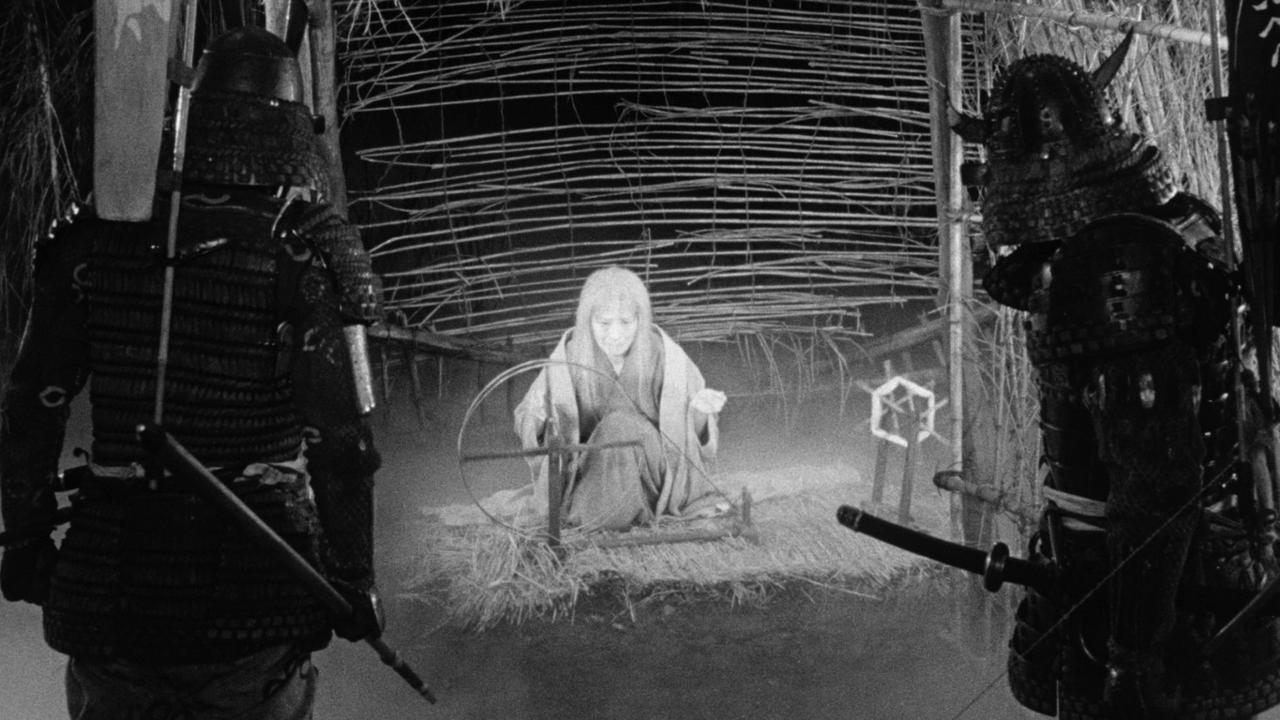
WHAT JON THOUGHT: If Kurosawa’s adaptations of Russian literature have produced mixed results, his Shakespeare adaptations tend to fare much better. Enough of Macbeth‘s plot and structure remains in Throne of Blood to be recognizable. After receiving a prophecy of future glory which is immediately partially fulfilled, Toshiro Mifune’s Washizu quickly descends into paranoid scheming with his wife (Isuzu Yamada’s Lady Asaji) which results in a string of murders. Kurosawa however, not beholden to Shakespearean setting or dialogue, transforms it into a Japanese period piece. Visually this feels like Kurosawa’s biggest movie to date, with exterior castle sets and dozens of mounted samurai representing the various armies at play. At other times, he chooses a more atmospheric path with extended sequences of his characters roaming the fog-covered forests. The encounters with Chieko Naniwa’s Witch character are particularly surreal. That Throne of Blood covers a wide range of moods while adapting one of the most famous plays in history in just under two-hours is a minor miracle.
ANYTHING ELSE, CHRIS? Not a lot to add here, except to re-emphasize how incredible Kurosawa is in using space and movement. One of my favorite moments involves Yamada’s Lady Washizu and the blood on the floor. The moment of still is almost interminable. Kurosawa slowly draws the camera closer to her as she sits center frame. It holds there for almost a minute as she sits, slowly turning her head from left to right, as if she can hear something. Suddenly she jumps, and the camera whips with her as she spins in a circle to fall to her knees at the blood pooling on the steps. It’s a magnificent moment made with almost nothing, Kurosawa letting the camera and Yamada’s movements tell you all you need.
That use of space, even negative space, is brilliantly exploited at Throne Of Blood’s end, where, after the climactic arrow shooting (still absolutely marvelous 70 years later), Mifune looks down at the archers. The smoke that surrounds their feet is stunning, painting an otherworldly picture that makes the events even more heightened. When Mifune finally collapses at the feet of the army, it’s one of the most haunting images I’ve ever seen, especially watching the scene transition to the trees, now also covered in the fog that blanketed the violence. Just stunning on every level.
ANYTHING ELSE, JON? I really need to underscore Chris’s comments about the two lead performances. Sure, actually having real archers shoot dozens of real arrows with pinpoint accuracy within inches of Toshiro Mifune must have really set fire to his performance of that climactic scene. Even before that, however, Mifune is fully engaged at all stages of Washizu’s perilous descent. You believe him when he refuses to betray his master. You believe him when he begins to doubt and plot. You believe him when he scrambles to keep their scheme from falling apart completely. And like Chris, I truly think Mifune is nearly upstaged by Isuzu Yamada as Lady Washizu. Where Mifune is all rage and movement, Yamada is eerily still, uncowed by Mifune’s presence. She draws the viewer in closer to try to figure her out as she betrays nothing in her expression. If I have any complaints about this movie, it’s that she is not as present in the second half of the movie.

THE FINAL WORD(S): For Chris and Jon, Throne of Blood is a stellar adaptation and a visual feast, brilliantly showcasing every aspect of Kurosawa’s talents.
NEXT TIME: We head back to the world of Russian literature with an adaptation of Gorky’s The Lower Depths. Let’s pray it’s more successful than Kurosawa’s last foray…
 Cinema Dual
Leave a comment