

Something Like a Filmography takes a (brief) look at the filmography of Akira Kurosawa. Twice a month, Chris and Jon share their impressions of each film, both on its own terms and in terms of Kurosawa’s legacy and its intersection in the Cinema Dual hosts’ lives.
FROM THE BOX: One of the most thrilling movie epics of all time, Seven Samurai (Shichinin no samurai) tells the story of a sixteenth-century village whose desperate inhabitants hire the eponymous warriors to protect them from invading bandits. This three-hour ride from Akira Kurosawa—featuring legendary actors Toshiro Mifune and Takashi Shimura—seamlessly weaves philosophy and entertainment, delicate human emotions and relentless action, into a rich, evocative, and unforgettable tale of courage and hope.

WHAT CHRIS THOUGHT: I learn something with every viewing of Seven Samurai, and maybe more than anything else that is its ultimate gift. This time it was the realization that Kurosawa allows no distance, his filmmaking so masterful that he refuses to allow the audience a measure of distance from the story being told on screen. I can chalk it up to age, to admittedly being overly sentimental, but there are so many scenes in this film that can instantly bring me to tears. It’s the performances, sure…but those performances can’t live without Kurosawa’s deft hand. I’m especially reminded of the scene where Kambei (played to perfection by Takashi Shimura in the only role that rivals his performance in last year’s Ikiru) is made to realize that in giving them rice to eat, the farmers are literally giving them everything they have as payment for the bandits. Kambei’s face changes, and Kurosawa stages a beautiful shot of the bowl of rice in the foreground, the farmers in deep focus layered in the back as Kambei intones, “We will not let this rice go to waste.”
Seamlessly balancing battle set pieces and emotional passages with the same sense of kinetic action and dynamic camera work, Seven Samurai is zero waste despite being over three hours long. Not a moment of the film can be put aside, and it’s a master course in how to use the camera in motion, with sections I can feel pulse in the films of other master directors: in the shots of the samurai working with the farmers to prepare for the bandit’s return I can see Spielberg using it as a frame of reference in Raiders of the Lost Ark when Indy oversees the digging in the desert. Another item that really jumped out on this viewing (with special thanks to Michael Jeck’s commentary on the Criterion disc): the way Kurosawa uses different transitions for different things, particularly the wipe to note an ellipsis, or the use of wind and sever weather for particularly dramatic moments (the wind whipping up for our amazing introduction to Shimura’s Kambei, still my favorite character introduction of all time), or the way Kurosawa extends time in his cuts, particularly in the exquisite duel scene that introduces us to the master swordsman Kyūzō. The amount that happens in this genius work of cinema is equalled only to the amount I learn – about it and myself – with each viewing.

WHAT JON THOUGHT: By this point in Kurosawa’s career, we’ve seen him grapple with interesting themes, innovate cinematographic techniques, use music to brilliant effect, and draw out fascinating performances from his stable of actors. Seven Samurai has all of these of course, but adds a sense of scale. Apparently the most expensive Japanese film at the time of production, the money spent certainly shows on screen. Kurosawa chose to build the village instead of shooting at Toho studios. The large number of extras needed to represent the villagers and bandits would all require their own costuming. If Rashomon was a movie that was influenced by its budget, Seven Samurai certainly was as well, but to very different effect.
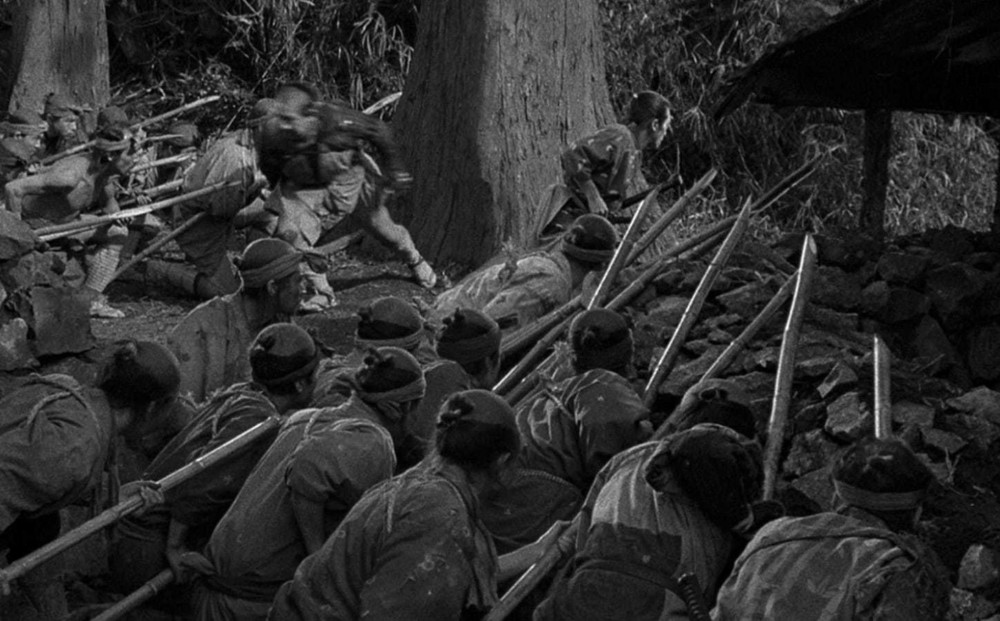
This comes to a head in the film’s breathtaking battle sequences, requiring massively coordinated choreography between all human (and non-human) participants. While today’s movies can create large scale battles with a team of skilled VFX artists, I always have a soft spot for directors who, not having that option, solve the problem by putting dozens if not hundreds of people in costume into frame and yelling “Action!” The pouring rain and resulting mud in the finale enhances the stakes of the fight, as samurai struggle to stand, let alone fight. Finally, these battle sequences also stand out because of how they are coherent and driven by character choices, and not the other way around. This shouldn’t be a surprise for Kurosawa, but considering how influential this movie is, not everyone learns that particular lesson.
ANYTHING ELSE, CHRIS? In keeping with the theme of always finding something new with one of my favorite films, this time it was the parallel between young Katsushirō and Kikuchiyo’s journey throughout the film, each looking for acceptance, although their manner in how they find it diverge greatly until the end. Katsushirō, a young man with means but little experience yearns for the latter and finds it in Kambei’s heroic bravery and later Kyūzō‘s skill. Mifune (a revelation in this film, which is saying something considering his already looming catalog of incredible performances) is the exact opposite: Kikuchiyo has no means but plenty of experience, having truly felt the plight of those he swears to protect, yearns for acceptance, but one of equal footing in the eyes of those for whom in his eyes are just as much to blame for the cycle of violence. In a second half that is all battle, both men grow into the samurai they wish to be, but the price is great, with Mifune in particular creating perhaps the most electric performance of his career. I tell no lies when I say on what is probably over a dozen re-watches of this film I still cry for him in his pain and anguish, but not at his death, because it’s there he finally finds peace.
“In the end, we lost this battle, too” Kambei says. There are no other words to say.
ANYTHING ELSE, JON? Speaking of the film’s influence, while its successors may condense the runtime in a way that makes more casual viewings more pragmatic, I really like how Seven Samurai takes the time to develop the characters and their relationships to each other while not skimping out on the more archetypal moments. This is especially prevalent in Kikuchiyo’s big monologue when the dead samurai gear is discovered, which also in turn informs Manzo’s reaction to his daughter Shino’s relationship with the young samurai Katsushirō. Aside from Kikuchiyo who is clearly positioned as comic relief at first, we never really see our samurai as acting less than heroic to earn the villagers’ distrust. And yet, Kikuchiyo’s monologue not only gives him more depth than we anticipated, it also establishes a tense distrust between the two groups of people that has to be dealt with before moving onto the larger battle. A more conventional movie might elide these kinds of conflicts.

THE FINAL WORD(S): For Chris, this is the masterwork, the film by which all action epics are measured, a classic that draws you in and refuses to let go for far longer than simply its runtime. For Jon, he can only agree with Chris’s well stated words.
NEXT TIME: We return to contemporary post-war Japan, and the fear of nuclear annihilation for I Live In Fear.
 Cinema Dual
Leave a comment