
Something Like a Filmography takes a (brief) look at the filmography of Akira Kurosawa. Twice a month, Chris and Jon share their impressions of each film, both on its own terms and in terms of Kurosawa’s legacy and its intersection in the Cinema Dual hosts’ lives.
FROM THE BOX: After finishing what would become his international phenomenon Rashomon, Akira Kurosawa immediately turned to one of the most daring, and problem-plagued, productions of his career. The Idiot, an adaptation of Fyodor Dostoyevsky’s nineteenth-century masterpiece about a wayward, pure soul’s reintegration into society—updated by Kurosawa to capture Japan’s postwar aimlessness—was a victim of studio interference and, finally, public indifference. Today, this “folly” looks ever more fascinating, a stylish, otherworldly evocation of one man’s wintry mindscape.

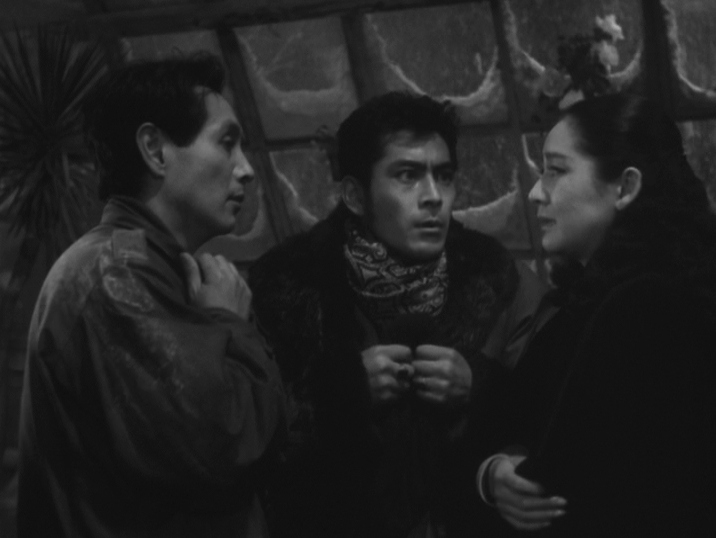
WHAT CHRIS THOUGHT: With their intense focus on the human condition, it’s easy to see why Kurosawa considered Dostoyevsky a kindred spirit, and over the course of the three sittings I needed to finish The Idiot I found myself slowly falling into the film’s many charms. This feels like the first time Kurosawa uses winter as more than a simple set piece, and the way he shoots the capped houses and gentle snowfalls of Hokkaido is luscious – there’s a scene where Kameda (a beatific Masayuki Mori) and Ayako are walking down a tree-lined street that is permanently burned into my brain. And Kurosawa’s framing of his main characters into threes had me thinking a lot more about the exquisite technical mastery of the film rather than its plot.
Which really can’t be helped, because finding the small moments of beauty (the whole scene at Taeko’s party culminating in the throwing of 1M yen into a fire) doesn’t overcome how incredibly convoluted that plot is. I had to re-start the film multiple times to understand the different character motivations in the first 30 minutes, and although I’m aware this was supposed to be two films and over 100 minutes were cut, I can’t see how Kurosawa would have ever found his way out of this maze of melodrama, angst, and indecision.
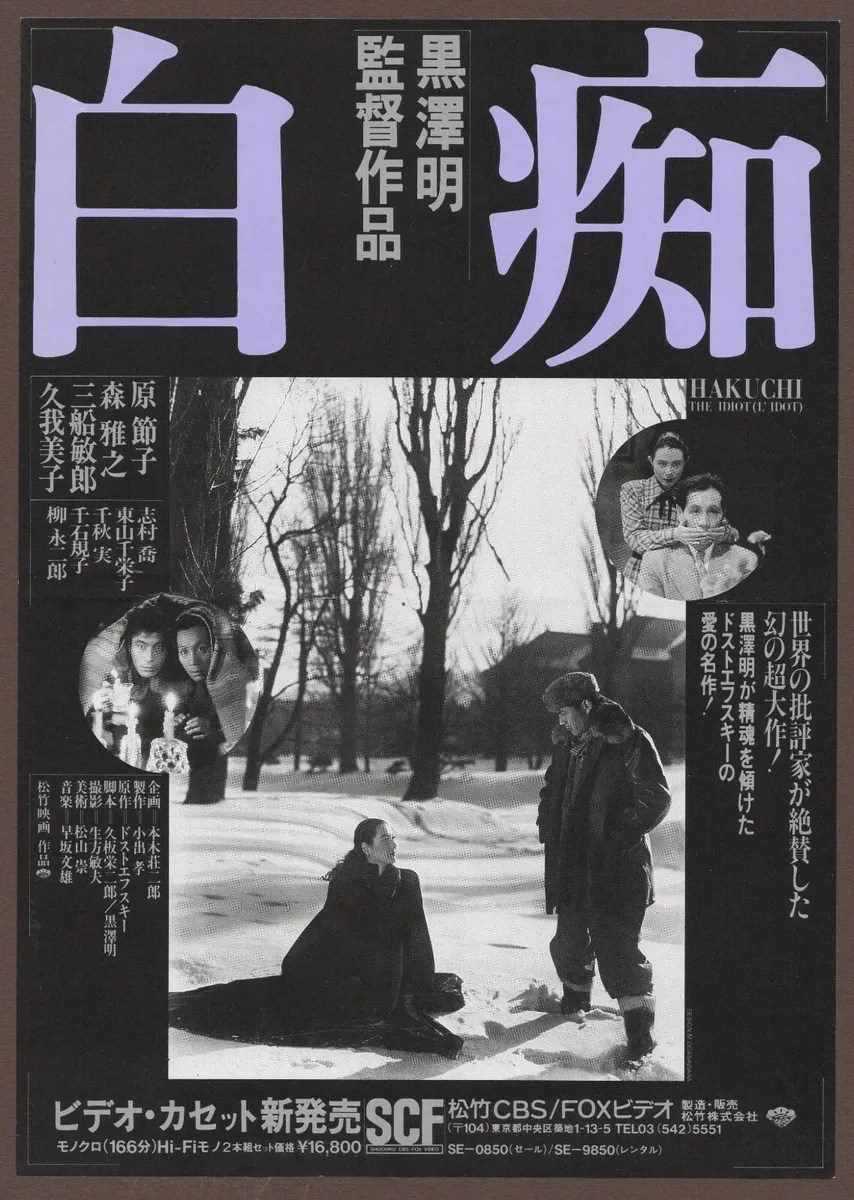
WHAT JON THOUGHT: After an opening subtitle “Part 1: Love and Agony”, and an introduction to Kameda and Akama, where Kameda describes his epileptic dimentia as “idiocy”, Kurosawa interrupts the narrative with intertitles offering his commentary about Dostoevsky’s equation of goodness with idiocy. At first, this can be seen as a interestingly post modern take on adaptation, as Kurosawa isn’t just adapting his hero’s book, he’s putting himself into the movie very directly. It of course makes sense that this is a passion project for Kurosawa, who fresh off the success of Rashomon, wants to use his clout to pay tribute to one of literature’s greats.
Very quickly however, the audience is subject to an unhealthy amount of plot by way of lengthy intertitles, with additional bits of VO narration to catch us up on plot developments we haven’t seen. This is because the existing version of this film is missing 100 minutes cut by the studio Shochiku. Apparently Kurosawa’s desire to faithfully reproduce the novel resulted in a 4+ hour cut that tested disastrously and was never released. The studio cuts however likely do not improve on the film as the end result is a confusing, 3-hour mess. Kurosawa’s opening thesis statement is all I really have to go on when watching this movie. Even the musical cues, which Kurosawa often brilliantly uses to evoke particular moods, often feel oddly misplaced. I love when film directors get ambitious with their projects, and The Idiot is ambitious. It’s just surprising that this movie’s plot is more obscure than Rashomon, a movie about obscuring the plot.

ANYTHING ELSE, CHRIS? I think the second half of The Idiot starts to bring things together for me: this is largely a film about trauma. Kameda’s idiocy is there result of massive trauma received during the war when he was almost killed by firing squad; Taeko’s trauma stems from sexual abuse from a young age at the hands of an older man. Akama’s abuse at the hands of his father shapes him as much as anything else, and how those forces collide in the three characters is devastating, even through the morass of plot.
The fact that this shines through at all is a credit to the lead performances: Mifune looks like he’s seething, ready to burst at any moment as he plays one of his most despicable characters to date, even if we may sympathize with his plight. As the titular character, Masayuki Mori may seem to have the easiest role, but it’s one where he has to switch between the pure simpleton and the traumatized war veteran: the sequence where he slowly goes crazy to the sound of seemingly innocent snowbells on horses is a magnificent stretch. As the two women pulled in to the madness it’s an interesting trick to see how Kurosawa uses Setsuko Hara’s Taeko as a sort of femme fatale while Ayako, played by Yoshiko Kuga acts as both the audience surrogate and victim of Kameda and Agama’s obsession. The tragic and inevitable conclusion outlines all the preoccupations Kurosawa has both with Dostoyevsky and his own film works, and while the film as a whole doesn’t succeed, I was surprised at how much affected me during the journey to its end.
ANYTHING ELSE, JON? While a confusing 3-hour movie can be hard to recommend, there are aspects to appreciate. Toshio Ubukata as the cinematographer does manage to get some interesting shot compositions in The Idiot’s more grounded setting. The main characters are often interestingly positioned against each other and the camera. Speaking of the characters, I don’t really have any issues with the acting performances either. Toshiro Mifune continues to show that he can shine even in supporting roles as Akama. As I’ve been watching a lot of Ozu lately, it’s good to see Setsuko Hara as Taeko come back to work with Kurosawa again. Masayuki Mori has probably the biggest challenge as the titular idiot Kameda, but he mostly proves up to the challenge as he doesn’t succumb to the worst tropes of this kind of character. It really does make me wish we could have seen the original 4-hour cut just to know what it would have been.
THE FINAL WORD(S): For Chris, The Idiot may suffer from massive studio cuts and a lot of “tell don’t show” but still show some truly beautiful moments that point to Kurosawa’s masterworks to come. For Jon, if this movie can’t be as successful as Kurosawa’s masterpieces, it is at the very least a fascinating object.
NEXT TIME: We arrive at another towering achievement in Kurosawa’s career, and a beautiful focus on Chris’s beloved Takashi Shimura with Ikiru.
 Cinema Dual
Leave a comment