

Something Like a Filmography takes a (brief) look at the filmography of Akira Kurosawa. Twice a month, Chris and Jon share their impressions of each film, both on its own terms and in terms of Kurosawa’s legacy and its intersection in the Cinema Dual hosts’ lives.
FROM THE BOX: A handsome, suave Toshiro Mifune lights up the screen as painter Ichiro, whose circumstantial meeting with a famous singer (Yoshiko Yamaguchi) is twisted by the tabloid press into a torrid affair. Ichiro files a lawsuit against the seedy gossip magazine, but his lawyer, Hiruta (Kurosawa stalwart Takashi Shimura), is playing both sides. A portrait of cultural moral decline, Scandal is also a compelling courtroom drama and a moving tale of human redemption.
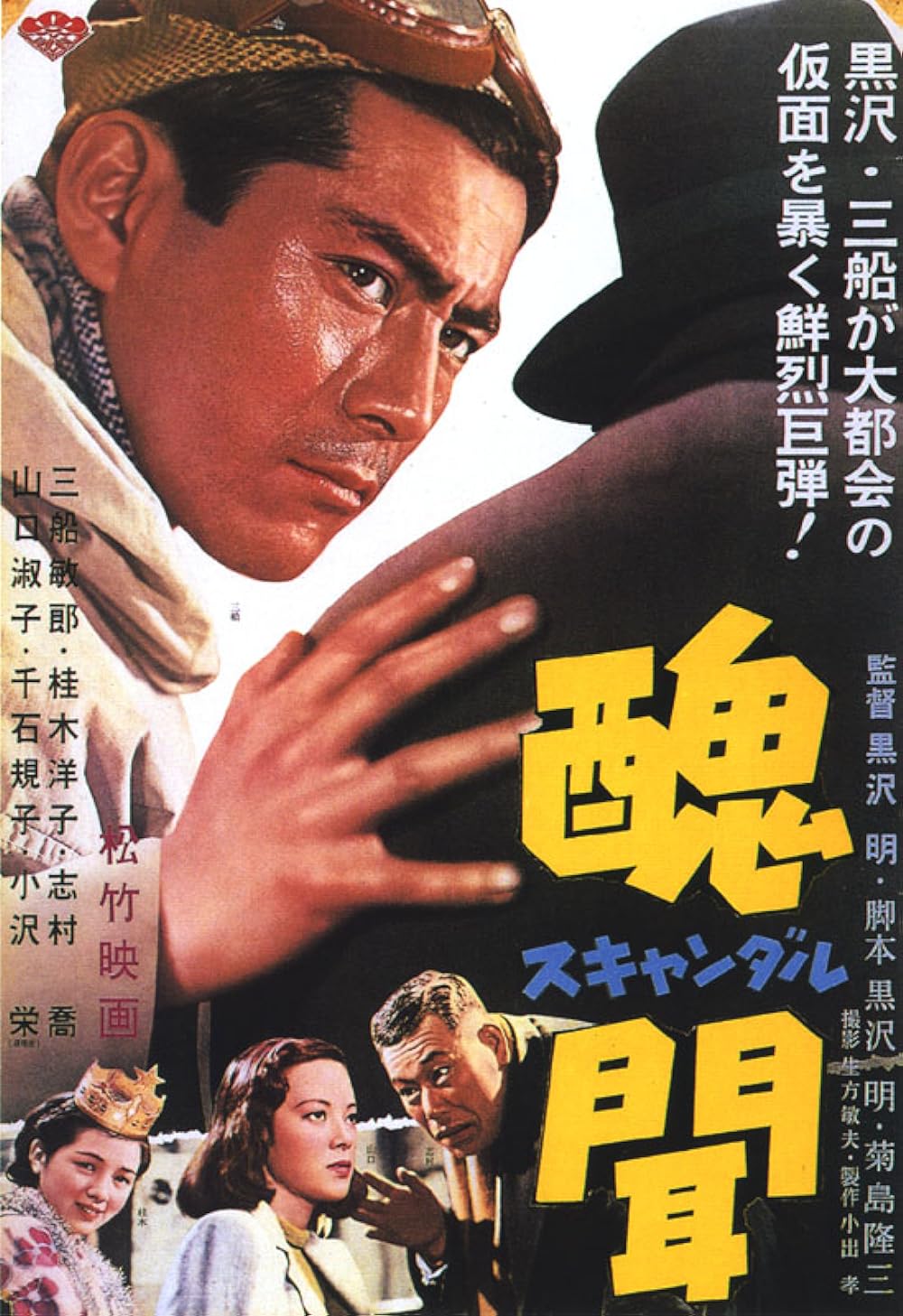
WHAT CHRIS THOUGHT: After the brilliance of Stray Dog, we return to slight, if still entertaining, melodrama. You can see the initial concept on Scandal – Kurosawa’s attempt to skewer the sleazy tabloid industry and its impact on an honest couple – slowly cave into the master’s preoccupation with sketching out more and more of Hiruta’s backstory. It’s interesting to see Mifune take the backseat: he’s almost distractingly handsome as the stalwart and honorable Ichiro Aoye, the painter who, in striking up an accidental friendship with singer Miyako Saijo, falls prey to the photojournalists who’ll do anything to get a story enough views to warrant a champagne dinner. He solid but really there to stand as the honorable pillar against which Takashi Shimura’s cowardly lawyer Hiruta will strive to emulate in truthfulness and honor. This is a spotlight for Shimura, who goes all out as the scoundrel who takes bribes and almost sells his soul under the illusion of getting enough money to help his ailing daughter.
On a technical level this is Kurosawa working everything he can into making the simple story visually arresting, from the scene of Mifune and the beautiful Yoshiko Yamaguchi passing a bus on a motorcycle, to Mifune traveling to the roof of a building to find Hiruta’s practice. But all the technical knowhow can’t save a story just a little too shallow and on the nose, let alone confused as to the story it wants to tell to be anything more than an interesting diversion in a master’s career.

WHAT JON THOUGHT: None of the individual sections of Scandal are in and of themselves lacking. The initial section, where the platonic friendship between Aoye and Miyako is purposefully twisted into a lascivious tabloid scandal, is a fun satire. Kurosawa can handle comedic moments well (as we’ll see in movies like Yojimbo and Sanjuro). The middle section with Hiruta foreshadows the masterful work that Kurosawa and Shimura will later collaborate on in Ikiru. The final section shows off a genre of filmmaking that we don’t often get to see from Kurosawa, the courtroom drama. And like the baseball sequence from Stray Dog, I would like to have seen him do that more.
The problem is that individual pieces don’t cohere into a whole movie. Kurosawa even admits as much in his autobiography, writing that he met a man at a bar that inspired him to write Hiruta’s backstory, which eventually overtook and swallowed the movie he had previously thought he was going to make. Modern viewers will also note what Kurosawa himself noted 40 years ago, that as a statement against fabulist tabloids, Scandal comes off as very mild. It has not lost its thematic relevance to our times, but our times have simply outpaced the movie on this subject on an exponential basis.

ANYTHING ELSE, CHRIS? I’m totally with Jon around the fact that Scandal never really takes its disparate pieces and combine them in a meaningful and satisfying way. It’s really two films jammed and held together with melodrama (sick girl who restores her father’s faith, anyone?). But that doesn’t stop Kurosawa from – as usual – finding some striking visuals to get his point across. I love the wall of tabloid covers he uses twice: once to show Mifune’s Aoye the rampant and viral reach of the slander, and then at the end when we see the same wall, all the covers ripped apart – showing that while this storm may have passed, it will only be replaced by something else.
ANYTHING ELSE, JON? I like Chris’s comments about Mifune being distractingly handsome in this movie because truly I believe he’s the one that truly pops in this film. Instead of the frantic rookie in Stray Dog, we get a much more relaxed and charming Mifune. For God’s sake, he’s a painter who rides a motorbike! You never once believe that the ride he offers Yoshiko Yamaguchi is anything other than a literal act of friendship, which is necessary to underline the crassness of the whole tabloid business. It’s actually kindof impressive that the depiction of the tabloids as a negative American influence on Japan didn’t provoke the ire of the American censors of the time. Maybe Mifune’s good looks distracted them too.

THE FINAL WORD(S): For Chris, Scandal is a slight detour where Kurosawa experiments with blending different stories together, something he’ll master with his next film. For Jon, Scandal has its own merits, but mostly is notable for how it presages how Kurosawa will deal with similar modes and actors in the future.
NEXT TIME: We hit the big time with the first masterwork of Kurosawa’s career, the Golden Lion and (honorary) Academy Award winning Rashomon.
 Cinema Dual
Leave a comment