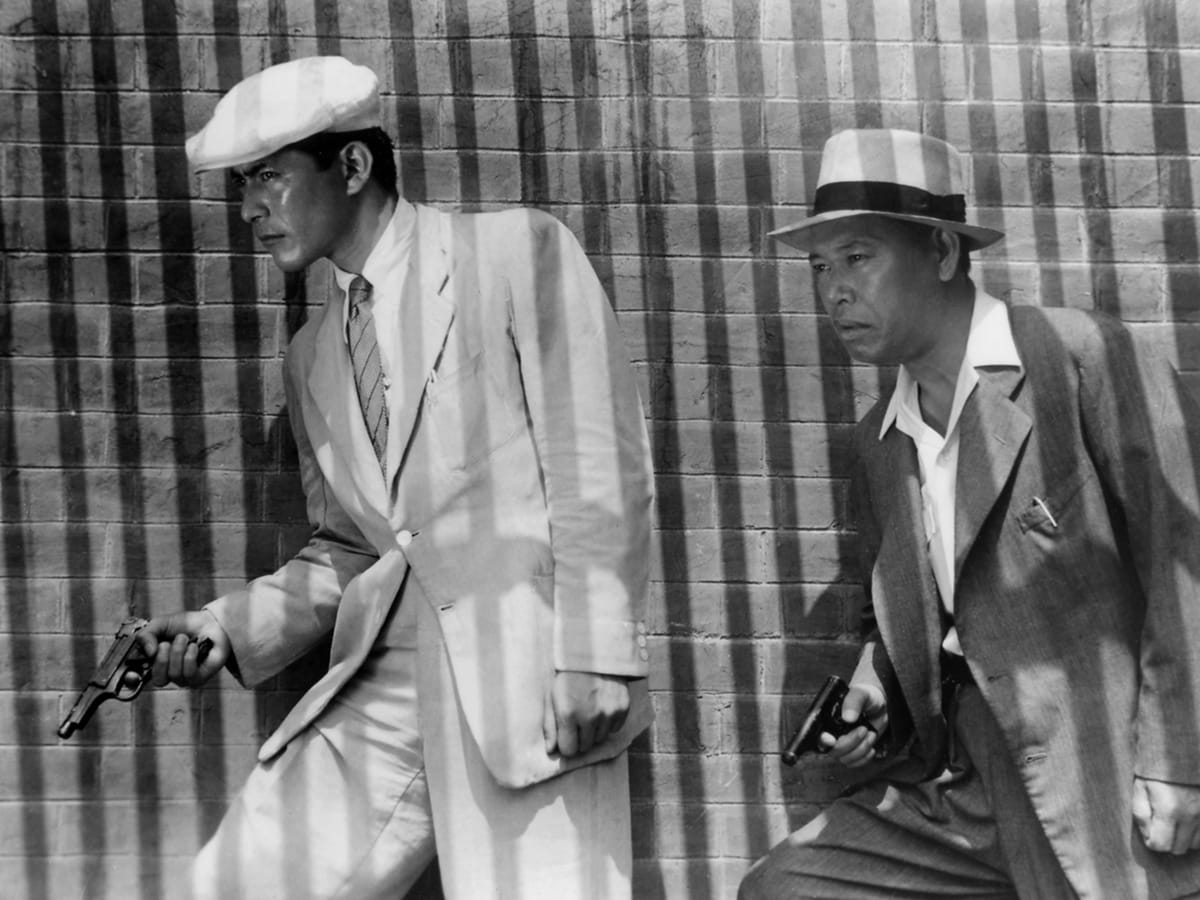
Something Like a Filmography takes a (brief) look at the filmography of Akira Kurosawa. Twice a month, Chris and Jon share their impressions of each film, both on its own terms and in terms of Kurosawa’s legacy and its intersection in the Cinema Dual hosts’ lives.
FROM THE BOX: A bad day gets worse for young detective Murakami when a pickpocket steals his gun on a hot, crowded bus. Desperate to right the wrong, he goes undercover, scavenging Tokyo’s sweltering streets for the stray dog whose desperation has led him to a life of crime. With each step, cop and criminal’s lives become more intertwined and the investigation becomes an examination of Murakami’s own dark side. Starring Toshiro Mifune as the rookie cop and Takashi Shimura as the seasoned detective who keeps him on the right side of the law, Stray Dog (Nora inu) goes beyond crime thriller, probing the squalid world of postwar Japan and the nature of the criminal mind.

WHAT CHRIS THOUGHT: Just watch that beginning. The extreme close-up of the panting dog. The sudden jump to the police station, the camera quickly pulling back to Murakami (Toshiro Mifune) exclaiming to his lieutenant his gun was stolen. Then quick cut to the past and the circumstances leading to the theft on a crowded bus, and an amazing overhead shot as Murakami sees the thief and gives pursuit, his hat falling off as he sprints out of frame. This is Kurosawa in full command of his powers, taking what could have been a standard run of the mill crime story and giving it a vibrant life that feels like it’s going to pop at any moment, boiling over from the heat of the city in mid-summer Kurosawa uses so well as a symbol for the rising tensions as Mifune (with a fantastic Takashi Shimura) attempts to catch the killer now using Murakami’s gun for his crimes. If Stray Dog were just a potboiler procedural I’d probably still love it, but Kurosawa also makes it another big commentary on post-war Japan, the Americanization of the country, and a social critique on class. There have been a number of fine films before this, but Stray Dog feels like the true starting point of Kurosawa’s genius.

WHAT JON THOUGHT: In the words of people younger than myself, we are so back. If The Quiet Duel suffered from a lack of things for Toshiro Mifune to do, then Stray Dog lets him fully off the leash (pun intended). As the rookie cop who gets his gun stolen from him, he stalks across the whole movie like a man possessed with a ferocity that almost makes you forget that his inexperience actually escalates the crimes he’s trying to prevent. He’s once again paired with Takashi Shimura, a more experienced cop who reins Mifune’s impulses in but also has no further interest in considering a world beyond “good guys” and “bad guys.”
This makes for a good buddy cop movie but what makes it better is how complex all the main characters are drawn. Kurosawa shows class divide in the movie, especially where the piano playing lady at the end is indifferent to the violence around her, and stifles a yawn. It’s revealed that both Murakami and Yusa come out of the war in particularly rough shape, a fact that Murakami can never shake. Yusa’s criminal ambitions start off as relatively modest, and only escalate out of necessity. His eventual death is proceeded by a lingering moment of full blown wailing and suffering. Murakami does take the more responsible path in the film from his own bad circumstances, but still does so selfishly at least at first. He only really pursues the crimes to which he feels a personal attachment, and with a recklessness that gets more people into trouble. If Kurosawa will ring the bell of “personal choice” often in his movies, then its done with a sophistication that can’t be boiled down to a simple didacticism.

ANYTHING ELSE, CHRIS? I was thinking back to Drunken Angel, and how now viewing Stray Dog it feels like that film was a necessary precursor to this, where Kurosawa would double down on the inventive storytelling to get closer to the heart of his cinematic preoccupations. It’s such a lively film, taking seemingly random detours (it feels like Kurosawa would have loved to just film and edit an entire baseball game) only to then set up thrilling set pieces that both push the central mystery along and comment on issues of class and especially the effects of war. It’s another bravura performance from Mifune, who plays the rash, inexperienced cop (sharing a name with my favorite living writer, coincidentally) as a nervous wreck, proving there were so many more facets to the man than we typically attribute to him. Shimura continues to be one of my favorites actors, and the way he situates Satō as the complete opposite of Murakami: cool, unbothered, and – despite being the senior, seasoned detective – exhibiting a cruel callousness about criminals that leaves an intentional sour taste in your mouth as the film ends. Just a great, classic movie I can watch time and time again.
ANYTHING ELSE, JON? Kurosawa is really starting to flex his shot composition muscles here. The task of following Mifune’s performance around itself requires a sense of motion that already does a lot of the work, but that’s not all. The incredibly hot weather also makes an impact here, as characters are constantly wiping down their very sweaty faces. When Mifune is talking to the pickpocket outside, Kurosawa fills the frame with multiple layers of action in foreground and background. At other times, like when Shimura is interrogating a suspect, or when Mifune is at the carnival game at the black market, the action is deliberately obscured.
There’s also some sequences that are interesting because of how infrequent they are in Kurosawa’s work. The aforementioned black market sequence was shot by Ishiro Honda of Godzilla fame by just shooting Mifune walking through the market in a way that evokes neorealist movies of the time. Similarly, Kurosawa never shot a lot in the world of sports sadly, and so the sequence at the baseball game stands out as well. Finally on a different note, I like how the movie starts immediately with the film’s premise of Mifune losing his gun, and then only filling in the circumstances of how it happened later. It really starts the film on an energetic note.

THE FINAL WORD(S): For Chris, this is the true start of Kurosawa’s genius streak. A noir/crime procedural that’s thrilling, exquisitely shot and stars one of the greatest acting pairs in cinema history hits all of his buttons. For Jon, this movie is a highly rewatchable and solid cop movie made better by the fact of being made by Kurosawa.
NEXT TIME: We enter the 1950s and Kurosawa (with Mifune and Shimura in tow) takes aim at the media with Scandal.
 Cinema Dual
This is my favourite film in which Takashi and Toshiro starred together. Love how Kurosawa seems to make you feel the heatwave through the screen. Brilliant flick that started the buddy cop genre.
LikeLike