Something Like a Filmography takes a (brief) look at the filmography of Akira Kurosawa. Twice a month, Chris and Jon share their impressions of each film, both on its own terms and in terms of Kurosawa’s legacy and its intersection in the Cinema Dual hosts’ lives.
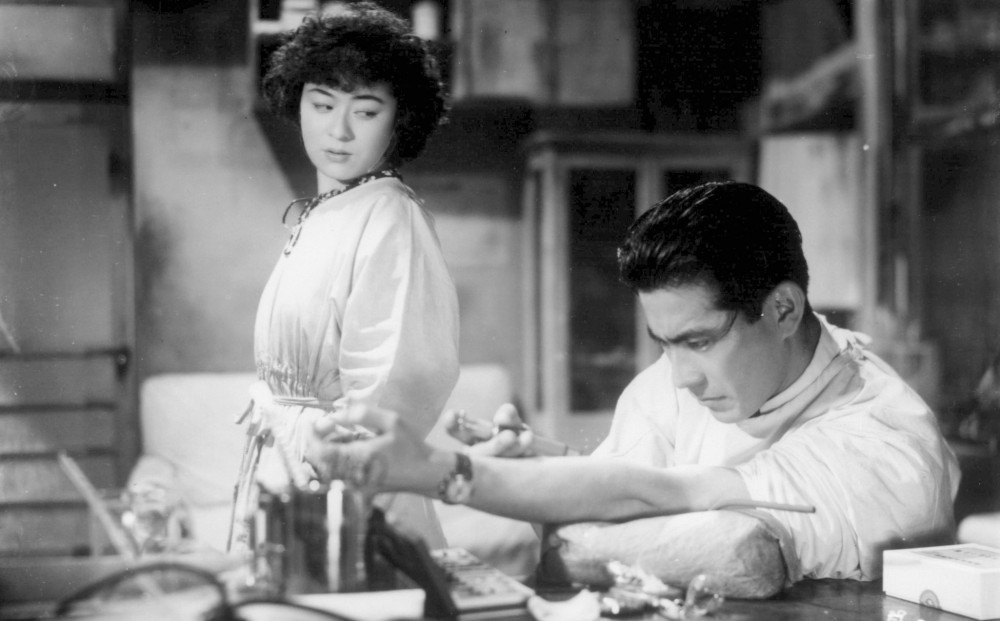
FROM THE BOX: A young idealistic doctor works at his father’s clinic in a small and seedy district. During the war, he contracts syphilis from the blood of a patient when he cuts himself during an operation. Treating himself in secret and tormented by his conscience, he rejects his heartbroken fiancée without explanation.

WHAT CHRIS THOUGHT: My immediate thought watching The Quiet Duel was “this is Kurosawa in full melodrama mode,” which sounds like a complaint except having someone like Mifune play completely against type as the noble physician sublimating his desires for his fiancee due to his condition never makes it boring or rote. The film does feel strangely muted: beyond one striking tracking shot in the hospital the film is largely static, Kurosawa opting to put all his focus on the faces of his leads. of which much should made of Noriko Sengoku as the young pregnant nurse who first despises then comes to love Mifune’s tragic hero. She brings some much needed passion and brightness to the film, and instigates the fabulous moment when Mifune finally breaks down and loses himself as he aches for a desire he will never act upon. She’s a marvel, and a perfect complement to Mifune.

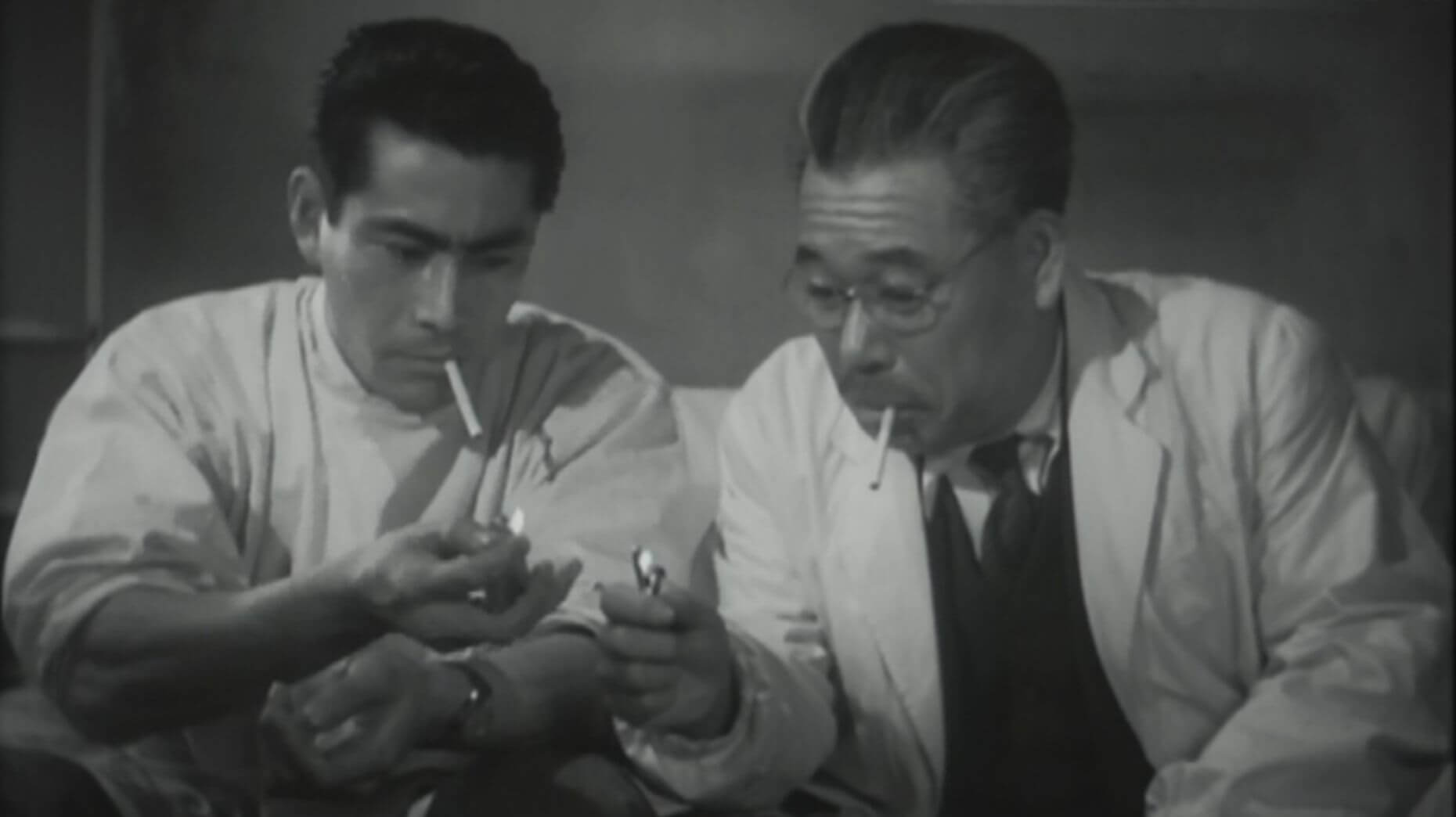
WHAT JON THOUGHT: I wanted The Quiet Duel, one of my very few first time watches in this series, to be a relatively hidden gem in Kurosawa’s career. There are moments where this bears out: in the second half of the movie, where Toshiro Mifune opens up enough about his struggles between his desire for his ex-fiancee and his personal responsibility to not spread his illness to Takashi Shimura and Noriko Sengoku, the stellar performances are captivating. It’s even made more potent contrasted against Kenjiro Uemura’s Nakada who, faced with the same illness as Mifune, does not take his responsibilities seriously, to incredibly tragic results for those around him. Ultimately what holds the film back is plotting. Almost nothing happens in the first half of the movie, just Mifune rehashing the basic plot beat of “I broke off my engagement so that I wouldn’t spread my illness.” One of the reasons Sengoku shines in this movie is specifically because she’s the only one with anything to do in the first half, even if that’s just to be mistakenly mad at Mifune. Kurosawa in his autobiography describes his ideas for the movie as not being “thoroughly digested” and when a relatively short Kursoawa movie could reasonably cut down by a third, I’d have to agree.
ANYTHING ELSE, CHRIS? There’s a telling anecdote in Richie’s The Films of Kurosawa, where Kurosawa confides that once the film leaves the confines of the field hospital the film loses its drama. Not only the drama but the life: with small exceptions you can feel Kurosawa moving through the picture with little engagement. I think some of this also has to do with Kurosawa moving over to Daiei, where not only was he working in a new studio, but was also wrestling with the American censor board, who refused to allow Kurosawa to film his original ending of Mifune going insane. Having to deny his leading man the power of a spectacular finish, The Quiet Duel feels somnambulistic in its pacing and eventual conclusion. Another interesting facet I clung to in my reading and viewing was the nature of the disease. For a filmmaker intensely interested in the human condition, there is little being said in the film. Syphilis doesn’t sit in for a larger societal concern, it’s just the thing that happens that Mifune has to deal with. There’s little about the stigma of the disease, or the social factors of post-war occupation that might lead to its rise. Instead it’s the MacGuffin that forces the drama. A rare misfire for Kurosawa that I still as Jon said in his earlier section find small gems within.
ANYTHING ELSE, JON? I do think it’s worth saying that there is a baseline filmmaking competency here that keeps it from living at the bottom of Kurosawa’s filmography. I do like the way he shoots the first scene in the war when Mifune is working on the infected patient. Mifune’s extended monologue where he finally breaks down is all the more powerful because the camera closely follows him as he stalks around the room without cutting. But if even Donald Richie can’t be bothered to devote much energy to The Quiet Duel in the plethora of his writings on Kurosawa, I’m going to let myself off the hook here.

THE FINAL WORD(S): For Chris, The Quiet Duel is an okay film hindered by lack of interest, something even the great performances from Mifune and Sengoku can’t fully save. For Jon, The Quiet Duel is a slightly below average outing for Kurosawa with some bright acting moments to make it still worth watching.
NEXT TIME: We prepare to leave the 40s behind and return to noir, pairing Mifune and Shimura as a pair of cops searching for a lost gun in the early classic Stray Dog.
 Cinema Dual
Leave a comment