

Something Like a Filmography takes a (brief) look at the filmography of Akira Kurosawa. Twice a month, Chris and Jon share their impressions of each film, both on its own terms and in terms of Kurosawa’s legacy and its intersection in the Cinema Dual hosts’ lives.
FROM THE BOX: The fourth film from Akira Kurosawa is based on a legendary twelfth-century incident in which the lord Yoshitsune and a group of samurai retainers dressed as monks in order to pass through a dangerous enemy checkpoint. The story was dramatized for centuries in Noh and kabuki theater, and here it becomes one of the director’s most riveting early films.

WHAT CHRIS THOUGHT: You can call The Men Who Tread on the Tiger’s Tail a lot of things, but for me it’s a Kurosawa masterclass in how to tell a great story in only 59 minutes. With just an hour we witness the spectrum of human emotion amid beautiful character moments. With two sets, no action and a minuscule cast we see how Kurosawa can ratchet the tension to the breaking point, convey poetry in a camera angle, and carve the totem of a character type that would come to define many of his later, greatest films. I loved seeing Susumu Fujita play a very different character here than he did in Sanshiro Sugata, the broad and yet striking performance from Ken’ichi Enomoto as the lowly porter, and the massive powerhouse performance of Denjirō Ōkōchi as Benkei, the fearsome general tasked with smuggling his Lord through a barrier in his brother the Shogun’s lands who wants him dead. It’s thrilling and tragic in equal measure, almost impressionistic in its style, and an utter joy to experience.

WHAT JON THOUGHT: It would be weird to call The Men Who Tread on the Tiger’s Tail an exercise, given that the conditions for its creation were “Japan lost the war and there is no money.” And yet, Kurosawa is able to make the most of a short script and a single outdoor set. The discussion between Denjirō Ōkōchi’s Benkei and Susumu Fujita’s Togashi at the barrier acts as the centerpiece of the film, with Kurosawa ratcheting up the tension by frequently cutting between all the players as Benkei tries to con Togashi into thinking the warriors are in fact a group of monks. While Ōkōchi is the MVP of this movie, I want to highlight Fujita here, as I think his straight laced performance here is a better fit than in the Sanshiro Sugata series. He has to be just gullible enough for his sidekick to issue with and eventually lose, but not so guileless as to not be a threat to our heroes. He would absolutely fit in as an admiral in Star Wars’ Imperial Navy.
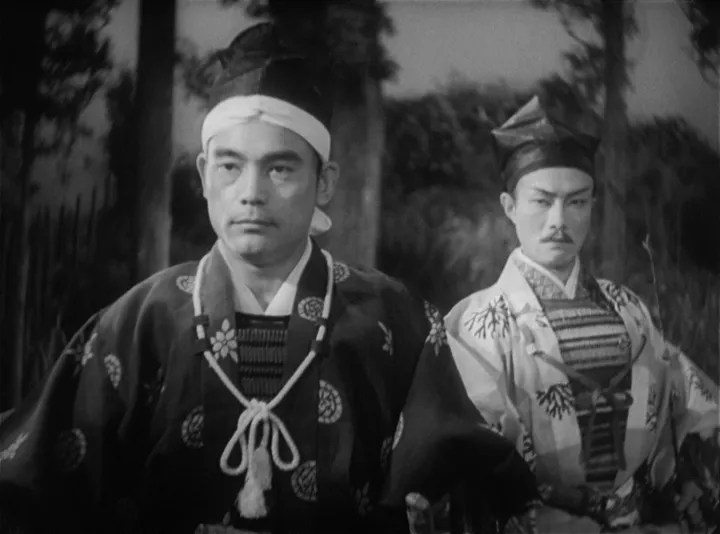
ANYTHING ELSE, CHRIS? I love the way Kurosawa plays on the other monks’ desire to simply kill the guards at the barrier and rush through, looking for death while the more wise and hardened Benkei reminds them that their first duty is to the protection of their Lord Yoshitsune, and then how that duty is literally turned around as Benkei as a last resort beats his Lord (disguised as a lowly porter) to ensure he is not detected. The pain of committing a cardinal sin in the eyes of feudal Japan is heartbreaking to Benkei, and sets up the sublime ending as, after being forgiven he loses his control by getting drunk and offering to dance…after Ken’ichi Enomoto’s porter first indulges in a wonderful display of drunken revelry. Only afforded the one set, Kurosawa finds some grand angles to shoot the barrier scene, particularly the moment the monks pray before their death. Watching this a second time I was so drawn to the relationship between Benkei and Susumu Fujita’s Togashi – Fujita plays it so neutral it’s hard to pin down whether he’s so committed to form he’s oblivious to the deception, or so smart he sees what’s happening but is so impressed with the performance he lets it slide. Early as it is in his filmography, this is first-rate Kurosawa.
ANYTHING ELSE, JON? Okay, I do want to talk about Ōkōchi’s Benkei after all, specifically the exchange where Togashi, in response to their false claims of being monks raising money to rebuild a temple, asks for Benkei to produce the documentation outlining their mission. He asks Ken’ichi Enomoto’s porter character to bring it to him, and Enomoto, knowing that such documentation does not exist, immediately starts panicking while digging up an empty scroll to give to Benkei. Benkei then proceeds to improvise a statement with so much bluster and intensity that Togashi can’t be convinced that it’s not real. The moment is only made sweeter by the increasing rage of Togashi’s sidekick, who is never swayed but is powerless to overturn his boss.

THE FINAL WORD(S): For Chris, this is a master class in doing so much with so little, and the true beginning of what he will come to love about the auteur. For Jon, this movie shows Kurosawa entering a new weight class of filmmaking, so to speak.
NEXT TIME: We move on to protests and love and see if there really are No Regrets For Our Youth.
 Cinema Dual
Leave a comment