

Shaken, Not Stirred takes a (brief) look at the James Bond canon from Eon Productions. Twice a month, Chris and Jon share their impressions of each film, both on its own terms and in terms of the cultural landscape as well as the genre it helped to create, not to mention its intersection in the Cinema Dual hosts’ lives.
FROM THE (LETTER)BOX(D): HAS JAMES BOND FINALLY MET HIS MATCH? A newly-developed microchip designed by Zorin Industries for the British Government that can survive the electromagnetic radiation caused by a nuclear explosion has landed in the hands of the KGB. James Bond must find out how and why. His suspicions soon lead him to big industry leader Max Zorin who forms a plan to destroy his only competition in Silicon Valley by triggering a massive earthquake in the San Francisco Bay.
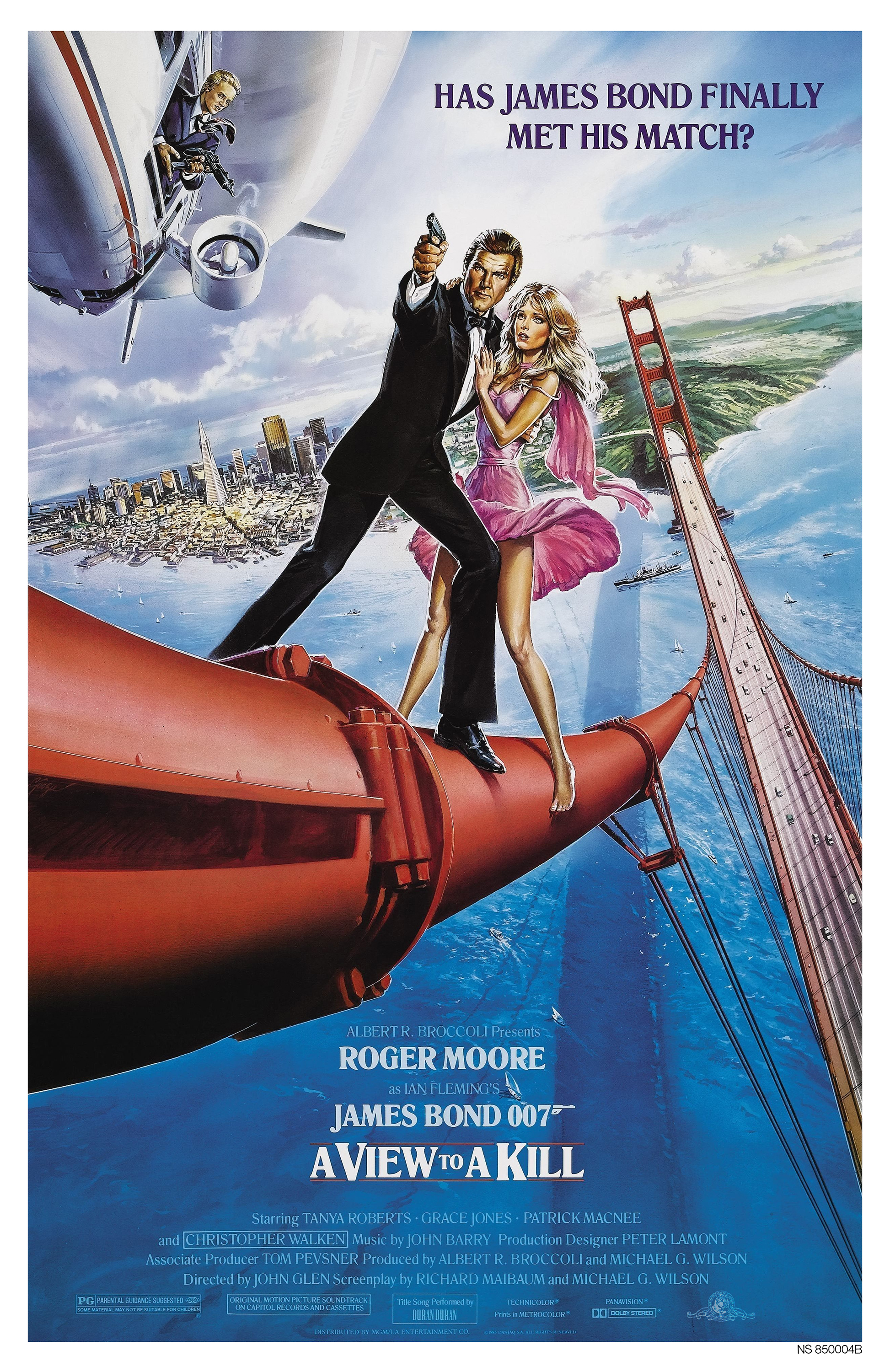
WHAT CHRIS THOUGHT: Man, what an exhausting film.
A View to a Kill should be the capper to Moore’s run, a proper send-off, one I (alone, apparently) think was accomplished in Octopussy. But I guess the Broccoli family wanted one more turn in the saddle, and the result is, for me, the most agonizing, painful version of James Bond we’ve seen yet, one who needs to wear a ridiculous hairpiece to make it easier for all the stuntmen to replace him in the film’s set pieces.
All that, and I still think Roger Moore might be my favorite Bond.
Ignore the pulsing nostalgia gland: yes, Christopher Walken plays the platinum-blond Zorin as the bastard product of Nazi eugenics he is, and Grace Jones is as much a visual delight as she is a terrible actress. And John Glen continues building the key thing that makes a Bond film for me: location after location after location. But it’s almost impossible to ignore the elephant in the room that is Moore’s age. Everything from the atrocious snowboarding sequence (whoever set that piece to the Beach Boys should be tarred and feathered) to the worst fight choreography to date shows just how limited Moore was in his farewell; you can practically feel Glen and the production team finding ways to shoot around Moore as much as possible. Walken and Jones prance around as the progenitors of what every Batman villain would do once Burton introduced us to Nicholson’s Joker a few years later, and as stupidly gorgeous as Tanya Roberts is, the fact that she was a childhood crush in the ’80s doesn’t save one of the worst Bond Girls on film.
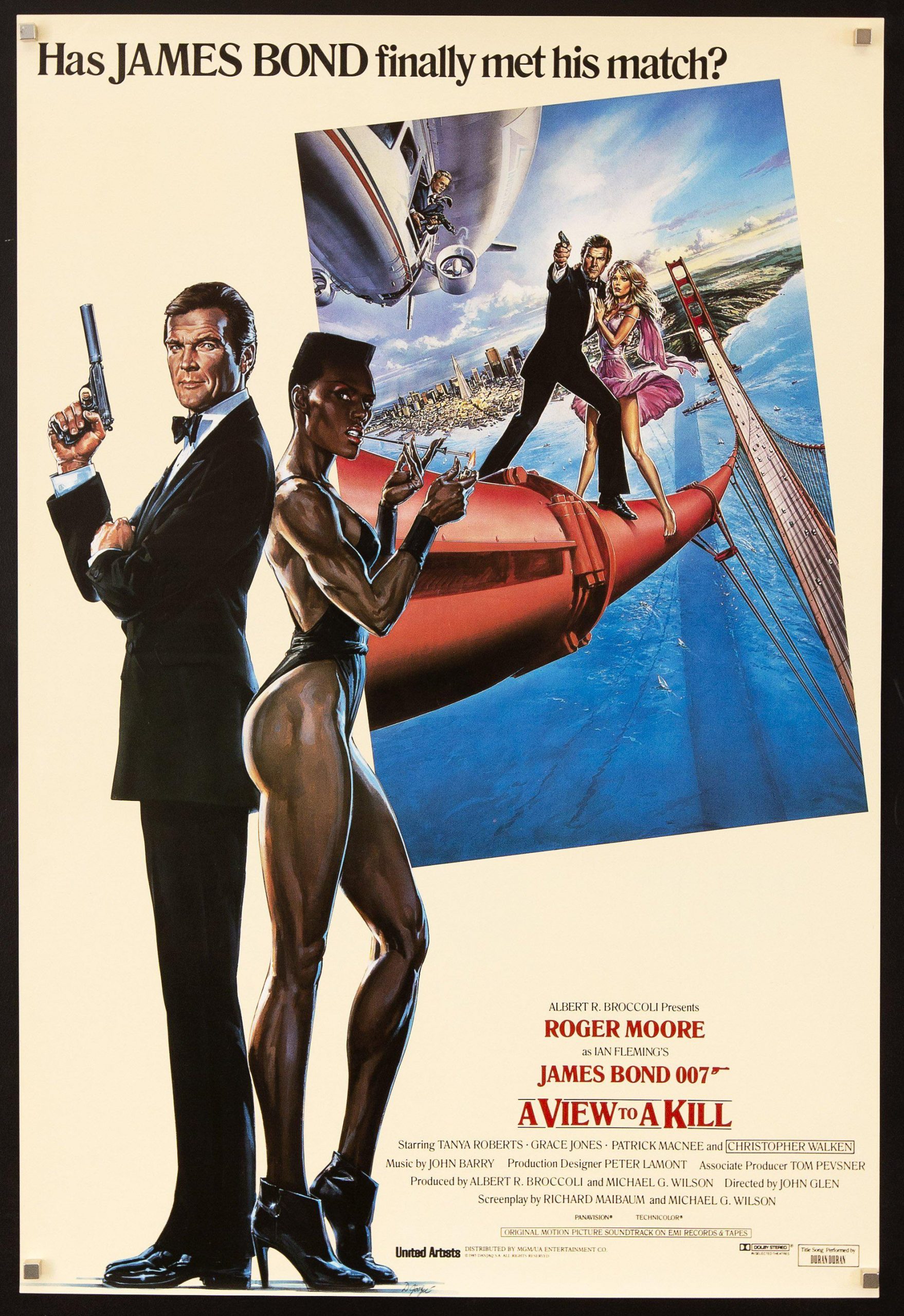
WHAT JON THOUGHT: The second great age of Bond has come to an end. It was certainly a sillier age than its predecessor, but when the great climax of the Connery era was storming a volcano lair with an army of ninjas, leaning into the silliness might have just about been the only way to keep the franchise going. To that end, I think Roger Moore’s more laid-back charm was a better fit for that direction. The only really deal-breaking problem for Moore, as anyone with a calendar and eyes can tell you, is that he should have retired at least two movies before he did. In A View to a Kill, it’s perfectly fine for M to tell Q to spare the lecture on modern microchips because we all know about them, but I don’t believe for one second that Roger Moore, who has credibly given exposition dumps for us in the past, knows anything about microchips. This particular plot device feels as though it is also signaling a shift in times and is preparing to leave Moore, like his predecessor, behind. Moore’s joke about women’s liberation in 1985 also inadvertently serves this function.
This is a bit of a shame, because the rest of A View to a Kill is a perfectly fun Bond adventure, firmly built around its villains. Christopher Walken appears to be having the time of his life as Zorin, the former Nazi experiment and current rogue KGB agent. I am now convinced more Bond villains should spend their time insulting Bond to his face. Walken also doesn’t hang back and gets fairly hands-on in all of the various schemes to kill Bond. And 40 years later, his scheme to destroy Silicon Valley essentially makes him the most sympathetic Bond villain by default.
That being said, the real juice of Zorin as a villain is that he doesn’t operate solo—he operates as half of a pair, with the film’s real star, May Day, played by the iconic Grace Jones. At the horse-race sequence, in a wide shot where every other person in attendance is dressed in their most elegant finery, the film introduces her by having her dressed like she’s in a Star Wars movie. Later, during the Eiffel Tower chase, I love the choice to have May Day don a covert disguise, because obscuring her face doesn’t fool anyone into thinking it’s not Grace Jones. I do think the choice for Zorin to ultimately betray May Day is largely cheap and unearned, but at least she gets a good death scene as a consolation prize. May Day might not have a golden gun, metal jaws, or a deadly hat, but by virtue of how Grace Jones handles herself on screen, May Day might be my new favorite Bond henchwoman.

ANYTHING ELSE, CHRIS? Random thoughts that buzzed in my head watching this film for probably the first time since seeing it in theaters:
- Why introduce someone with the fascinating name of Jenny Flex… and then do nothing with her?
- Man, they are really leaning into that Duran Duran song for the score, huh?
- Did Moore almost give us a “Little Moore” in that hot-tub sequence with the Russian spy?
- For every great location shot Glen gives us, why is he so bad at blending in the rear projection, especially when Moore’s age forces so much more of it?
- Is there ANY reason for the Russian subplot?
That’s it. This was excruciating for me in a way Octopussy and Moonraker weren’t. Onwards and upwards, I say.
ANYTHING ELSE, JON? f director John Glen still struggles to put together coherent plots with his screenwriters, then at least he still knows how to shoot action. He certainly knows how much I love randomly inserted ski-chase sequences in Bond films, as A View to a Kill opens with yet another one, which inexplicably features Bond snowboarding to a Beach Boys tune. It says a lot that May Day parachuting off the Eiffel Tower is just the beginning of a great chase, and the progressive destruction of Bond’s car is straight out of Looney Tunes. Other similar moments include the cop cars falling backward off the rising bridge and the chest of mishandled dynamite that blows up the blimp at the film’s conclusion.
In the land of supporting characters, Tanya Roberts unfortunately can’t rise to the occasion of delivering credible geological dialogue. Patrick Macnee as Tibbett fares a lot better as Bond’s horse-trainer buddy. I keep forgetting Robert Brown is the new M, which tells you what you need to know about him. The only really good moment for Q this time is when he gets to briefly play voyeur to Roger Moore and Tanya Roberts at the end.
We do have one more goodbye to say, however, and that is to Lois Maxwell. By the time of this movie, Maxwell is the only actor to have appeared in every Bond film to date, and while A View to a Kill doesn’t give Maxwell her best material, it will still feel slightly disorienting to not have Ms. Maxwell do her customary one scene of flirting with Bond. Along with Bernard Lee and Desmond Llewelyn, Maxwell supplies most of what on-screen continuity this franchise possesses.

THE FINAL WORD(S): For Jon, A View to A Kill is a perfectly fun adventure that deserved a younger star. Chris still wishes they ended with Octopussy.
NEXT TIME: THE NEW JAMES BOND…LIVING ON THE EDGE…IT’S THE LIVING DAYLIGHTS!
Leave a Reply